


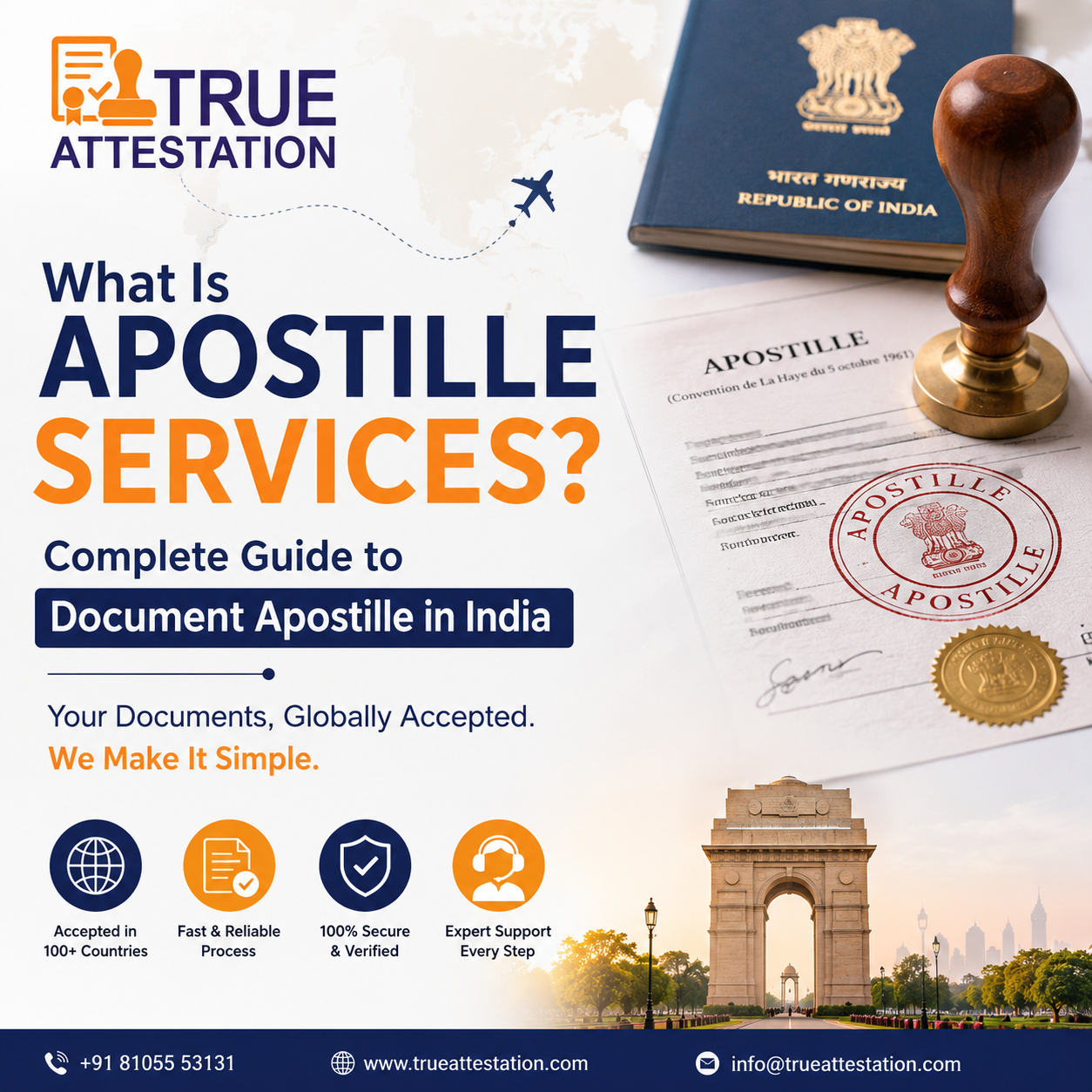
What Is Apostille? Apostille Services in Bangalore | Complete Guide
When an Indian document needs to be submitted for official use in another country, the receiving authority may require the document to be authenticated. What Is Apostille is one of the most common questions people have when they first encounter international document authentication.
An apostille is one of the important forms of international document authentication. People commonly come across apostille requirements when applying for overseas employment, higher education, immigration, residency, family visas, professional licensing, or other official purposes.
However, apostille is often confused with embassy attestation, MEA attestation, and document legalization. These are not necessarily the same process.
This guide explains What Is Apostille, why it is required, which documents may need an apostille, how the process works, and the difference between apostille and other forms of document authentication.
Important: Apostille requirements, procedures, fees, processing times, and supporting documents can vary depending on the destination country, document type, issuing authority, applicable government procedures, and requirements of the organization receiving the document.
What Is Apostille?
What Is Apostille? An apostille is a certificate or authentication used to help establish the authenticity of a public document when that document is intended for use in another country that recognizes the Hague Apostille Convention.
The apostille system was established to simplify the process of authenticating public documents for international use between participating countries.
Instead of requiring multiple diplomatic authentication stages in applicable cases, an apostille can provide a standardized form of authentication recognized under the Convention.
An apostille generally authenticates matters such as:
- The authenticity of the signature on the document
- The capacity in which the person signing the document acted
- The identity of the seal or stamp, where applicable
An apostille does not generally certify that every statement contained in the underlying document is true or that the contents have been independently verified.
For example, an apostille attached to an educational certificate does not mean that the apostille authority has evaluated the student’s academic performance. Rather, it relates to the authenticity of the relevant signature, seal, or stamp according to the applicable authentication procedure.
What Is Apostille Used For?
Understanding What Is Apostille also means understanding why this authentication may be necessary for documents being used abroad.
When an eligible Indian document is going to be used in a country that recognizes the Hague Apostille Convention, the document may need to receive an apostille before it can be presented to the relevant authority abroad.
The receiving organization could be:
- Government department
- University
- Employer
- Immigration authority
- Professional licensing body
- Court
- Registry
- Other official organization
Whether an apostille is actually required depends on the destination country’s rules and the purpose for which the document is being submitted.
What Does Apostille Mean?
The term apostille comes from French and is commonly understood in the context of the Hague Convention as a form of authentication for public documents.
In practical terms, What Is Apostille can be explained simply as a standardized authentication attached to an eligible public document so that it can be recognized for official use in another participating country.
The apostille does not replace the document itself. Instead, it authenticates relevant elements associated with the document, such as the signature, seal, or stamp, according to the applicable procedure.
What Is Apostille Under the Hague Convention?
The Hague Convention Abolishing the Requirement of Legalisation for Foreign Public Documents, commonly called the Hague Apostille Convention, provides a framework for simplifying the authentication of public documents used internationally.
Countries that participate in the Convention recognize apostilles issued according to the Convention’s requirements.
The purpose is to simplify the authentication process for eligible public documents.
Without an apostille system, document legalization may involve multiple authorities, including diplomatic or consular channels.
With the apostille system, an eligible public document can receive an apostille from the competent authority, subject to the applicable national procedures.
Important Point
The existence of the Hague Apostille Convention does not mean that every document automatically qualifies for an apostille.
The document must meet the applicable requirements, and the destination country must recognize the relevant apostille framework.
Therefore, when researching What Is Apostille, it is equally important to understand whether apostille applies to your particular destination and document.
Why Is an Apostille Required?
An apostille may be required when a public document issued in one country needs to be presented as an official document in another participating country.
The main purpose is to authenticate the origin of the document.
Understanding What Is Apostille is particularly useful for people preparing documents for international employment, education, immigration, family relocation, or professional licensing.
-
Employment Abroad
Professionals moving overseas for employment may be required to provide authenticated educational or professional certificates.
For example:
- Degree certificates
- Diploma certificates
- Professional qualifications
- Technical certificates
The employer, licensing authority, or government department may specify which documents need authentication.
-
Higher Education
Students applying to foreign universities may need authenticated educational documents.
These can include:
- Degree certificates
- Diploma certificates
- Mark sheets
- School certificates
- Professional qualifications
The university or educational authority determines whether apostille authentication is required.
-
Immigration
Immigration applications can require official documents proving education, identity, family relationships, civil status, or other information.
Depending on the immigration program, applicants may be asked to provide authenticated documents.
-
Residency Applications
People applying for residence permits or other residency arrangements may need authenticated civil or educational documents.
The exact requirements depend on the destination country and type of application.
-
Family Relocation
When moving abroad with family members, authenticated personal documents may be required.
These can include:
- Marriage certificates
- Birth certificates
- Divorce certificates
- Other applicable civil records
-
Professional Licensing
Some professions require applicants to submit authenticated qualifications before they can seek professional recognition or licensing in another country.
This can apply to certain regulated professions, depending on the rules of the destination country.
-
Business and Legal Purposes
Certain business, legal, or official documents may also require authentication for use internationally.
Examples can include:
- Powers of attorney
- Affidavits
- Company documents
- Commercial documents
- Legal declarations
The exact requirements depend on the receiving authority.
Which Documents May Require an Apostille?
There is no single universal list of documents that must be apostilled.
Requirements depend on the document, destination country, issuing authority, and purpose.
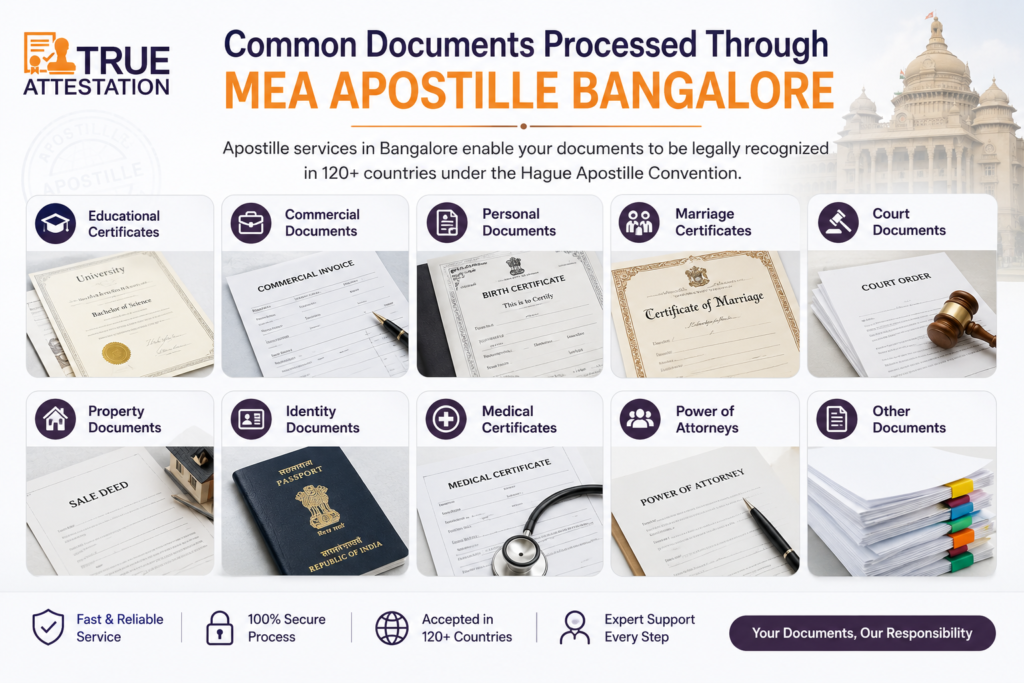
Common categories include educational, personal, legal, professional, and certain commercial documents.
If you are searching for What Is Apostille because you have a specific certificate or document, the first step is to determine whether that document is eligible and whether the receiving authority requires authentication.
Educational Documents
Educational documents are frequently used for international employment and education.
Potentially applicable documents include:
- Degree certificates
- Diploma certificates
- Mark sheets
- School certificates
- Professional certificates
- Technical qualifications
Degree Certificate Apostille
A degree certificate may need authentication before apostille processing, depending on the applicable procedure.
The exact requirements can depend on the institution that issued the degree and the destination country’s requirements.
Diploma Certificate Apostille
Diplomas and technical qualifications may also require authentication when submitted to overseas employers, educational institutions, licensing authorities, or government departments.
Personal Documents That May Require Apostille
Personal or civil documents can be important for family and immigration-related purposes.
Examples include:
- Marriage certificates
- Birth certificates
- Divorce certificates
- Death certificates
- Affidavits
- Other applicable civil documents
Marriage Certificate Apostille
A marriage certificate may be required when applying for:
- Spouse visas
- Dependent visas
- Family residency
- Immigration
- Family relocation
- Other official purposes
The applicable authentication process depends on the destination and the authority that issued the marriage certificate.
Birth Certificate Apostille
Birth certificates may be required for:
- Children’s visa applications
- Dependent applications
- Immigration
- Residency
- School-related documentation
- Establishing family relationships
The receiving authority may specify whether apostille or another form of authentication is required.
Commercial and Professional Documents
Certain commercial, legal, and professional documents can also require authentication for international use.
Depending on the circumstances, these may include:
- Power of attorney
- Commercial agreements
- Company documents
- Business records
- Professional certificates
- Affidavits
- Legal declarations
- Other official documents
Not every commercial document is eligible for or requires apostille.
The relevant authority should be consulted before beginning the process.
Apostille Process in India
The apostille process depends on the type of document and applicable government procedures.
If someone asks What Is Apostille process in India, the answer is that there is no single identical procedure for every document. Different document categories may have different preliminary authentication or verification requirements.
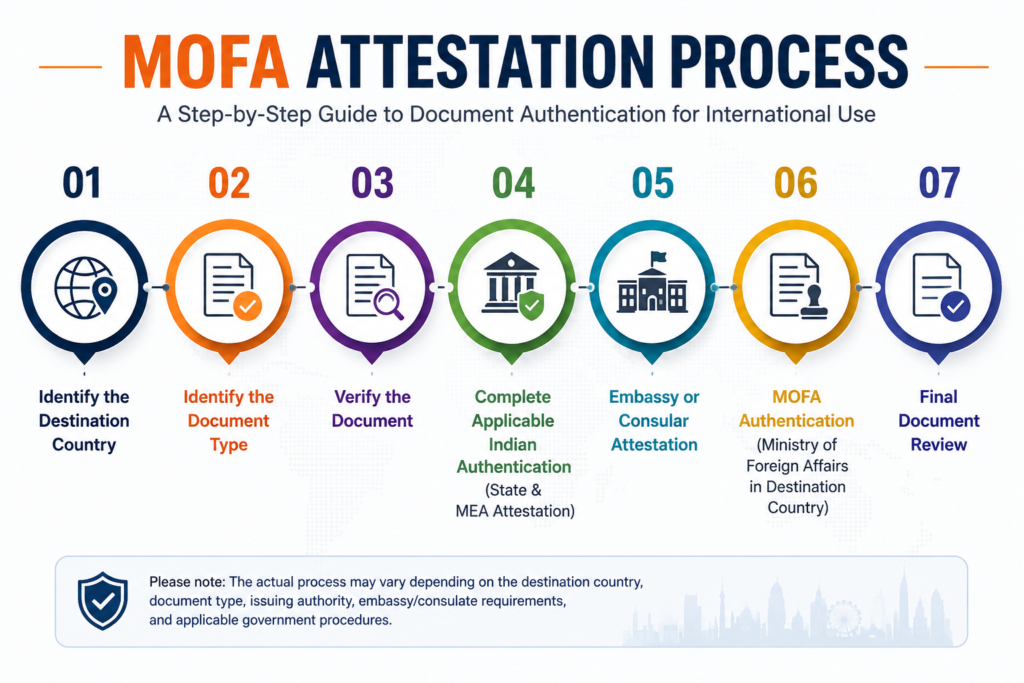
A general process can be understood through the following stages.
Step 1: Identify the Destination Country
First, determine where the document will be used.
This is important because apostille applies within the relevant Hague Convention framework.
If the destination country follows a different legalization system, apostille may not be the appropriate procedure.
Step 2: Identify the Document Type
Determine whether the document is:
- Educational
- Personal
- Professional
- Commercial
- Legal
- Other official documentation
Step 3: Verify the Document
Some documents may need verification or authentication by the issuing institution or relevant authority.
For example, educational certificates may be subject to requirements related to the university, educational board, or other issuing authority.
Step 4: Complete Applicable Preliminary Authentication
Depending on the document, applicable authentication may need to be completed before the apostille stage.
The exact procedure is not identical for every category of document.
Step 5: Apostille Authentication
Once applicable preliminary requirements have been completed, the document can proceed through the relevant apostille authentication process.
The apostille is issued or applied according to the applicable government procedure.
Step 6: Final Document Review
After apostille authentication, the document should be checked before being submitted to the overseas organization or authority.
It is important to ensure that the receiving authority’s requirements have been followed.
The actual process can vary depending on the document, destination country, issuing authority, and applicable government procedures.
Apostille vs Attestation
The terms apostille and attestation are often used interchangeably in casual conversations, but they can refer to different authentication procedures.
Apostille
Apostille is a standardized authentication under the Hague Apostille Convention for eligible public documents intended for use in participating countries.
Attestation
Attestation is a broader term that can refer to authentication or certification by an authority.
Depending on the destination, document attestation may involve:
- State-level authentication
- MEA-related procedures
- Embassy or consular attestation
- Other forms of legalization
Therefore, you should not assume that a request for “attestation” automatically means apostille.
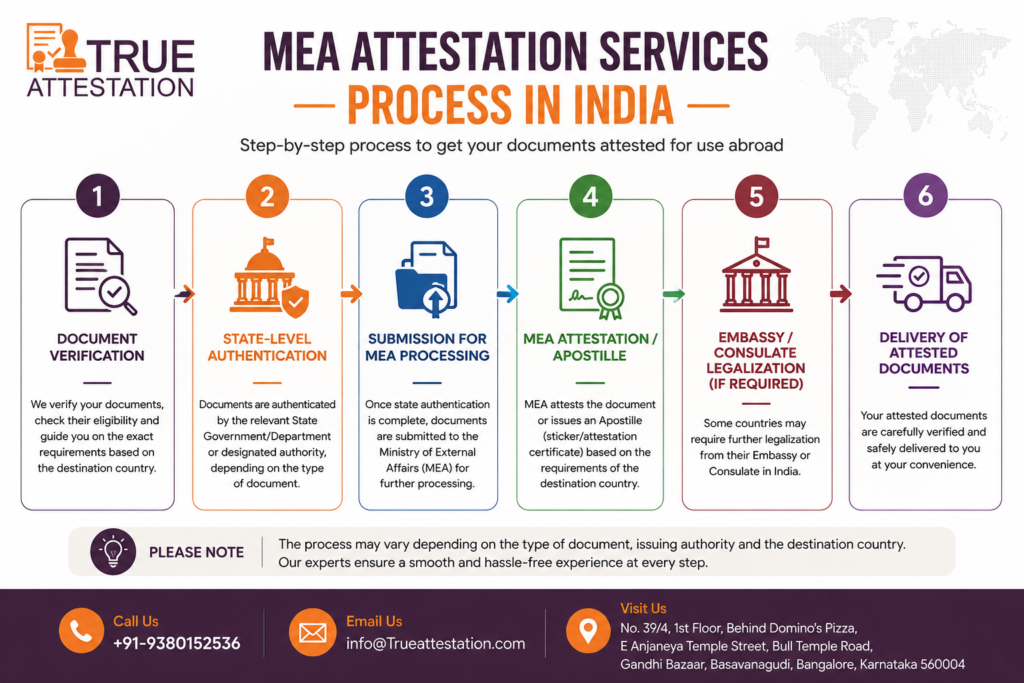
Apostille vs MEA Attestation
MEA refers to India’s Ministry of External Affairs.
Apostille is a particular authentication mechanism, while MEA-related authentication refers to processes involving India’s Ministry of External Affairs.
For eligible documents intended for countries recognizing apostille, the document may be processed under India’s applicable apostille framework.
The terminology can sometimes cause confusion because people may simply refer to the overall process as “MEA attestation.”
The correct procedure should be determined based on the destination country and document type.
Apostille vs Embassy Attestation
Apostille and embassy or consular attestation are also different.
Apostille
Generally used for eligible documents intended for countries that recognize the Hague Apostille Convention.
Embassy Attestation
May form part of a legalization procedure where the destination country’s requirements call for diplomatic or consular authentication.
The applicable process depends on the destination.
| Feature | Apostille | Embassy/Consular Legalization |
| Main purpose | Authentication under the Hague Apostille framework | Authentication through applicable diplomatic/consular procedures |
| Applicable destinations | Participating countries recognizing apostille | Countries/procedures requiring legalization |
| Main authority | Competent apostille authority | Relevant embassy/consulate and applicable authorities |
| Process | Depends on document and country | Depends on document and destination |
| Universal process? | No | No |
If you are researching What Is Apostille vs embassy attestation, the key point is that these are different authentication routes and the correct option depends largely on the destination country’s requirements.
Apostille vs Document Legalization
Document legalization is a broader term used for the process of authenticating documents for use in another country.
Apostille can be considered a simplified form of authentication under the Hague Convention framework.
For countries outside the relevant apostille system, traditional legalization procedures may be required.
This can involve several stages, potentially including government authentication and embassy or consular legalization.
Therefore, the destination country should always be identified before deciding which process is appropriate.
How Long Does Apostille Take?
There is no single processing time applicable to every apostille request.
Processing time can depend on:
- Document type
- Issuing authority
- Verification requirements
- Preliminary authentication
- Number of documents
- Government procedures
- Document condition
- Current administrative requirements
Educational documents can sometimes involve different preliminary requirements compared with personal documents.
For this reason, customers should avoid relying on a fixed processing time without checking the requirements for their particular document.
How Much Does Apostille Cost?
The cost of apostille services can vary depending on several factors.
These may include:
- Type of document
- Number of documents
- Applicable government fees
- Preliminary authentication requirements
- Verification requirements
- Service charges
- Additional documentation requirements
Educational, personal, commercial, and professional documents may have different requirements.
A specific quotation should therefore be obtained based on the actual documents and destination.
Does Apostille Guarantee Visa Approval?
No.
An apostille only relates to document authentication.
It does not guarantee:
- Visa approval
- Immigration approval
- University admission
- Employment
- Residency approval
- Professional licensing
- Any other government or institutional decision
The receiving authority independently determines whether an application or document satisfies its requirements.
Understanding What Is Apostille is therefore important, but applicants should remember that authentication is only one part of many international applications.
Common Mistakes to Avoid
Assuming Every Country Uses Apostille
Not every destination follows the apostille system.
Confusing Apostille With Embassy Attestation
They are different authentication mechanisms.
Not Checking the Destination Country
The destination should be established before starting the process.
Ignoring Document Type
Educational and personal documents can follow different procedures.
Submitting Incomplete Documents
Missing supporting documents can create complications.
Using Outdated Requirements
Government and institutional requirements can change. Always check current instructions.
Waiting Until the Last Minute
Authentication may involve multiple stages, so it is sensible to understand the requirements well before the document is needed.
Do All Documents Need Apostille?
No.
Whether a document needs an apostille depends on several factors:
- Destination country
- Purpose of the document
- Document type
- Receiving authority
- Issuing authority
- Applicable international arrangements
- Current government requirements
For example, an educational certificate submitted to a foreign university may have different requirements from a marriage certificate submitted for a family visa.
Therefore, customers should not assume that every document requires apostille.
Can Digital Documents Be Apostilled?
The answer depends on the applicable country’s rules, the type of document, and the competent authority.
Some countries and authorities support electronic authentication or e-Apostille systems for eligible documents.
However, not every document or country follows the same system.
If an organization specifically requests an electronic apostille, the applicant should confirm the accepted format and applicable procedure with the relevant authority.
How to Know Whether You Need Apostille
Before beginning the process, collect the following information.
Destination Country
Where will the document be submitted?
Purpose
Why is the document being submitted?
For example:
- Employment
- Education
- Immigration
- Residency
- Family visa
- Business
- Professional licensing
Document Type
What document are you submitting?
Receiving Authority
Who requested the document?
It could be:
- Employer
- University
- Embassy
- Immigration department
- Government authority
- Licensing body
Specific Instructions
If the receiving organization has provided written instructions, review them carefully.
This information can help determine whether apostille, embassy attestation, legalization, or another authentication procedure may apply.
Frequently Asked Questions About Apostille
- What Is Apostille?
What Is Apostille? An apostille is a form of authentication used for eligible public documents intended for use in countries that recognize the Hague Apostille Convention.
- What Is the Purpose of an Apostille?
Its purpose is to authenticate the origin of a public document for international use under the applicable apostille framework.
- Is Apostille Required for Every Country?
No. Apostille applies to countries recognizing the relevant Hague Convention framework. Other countries may require legalization or consular attestation.
- Which Documents Can Receive an Apostille?
Depending on applicable rules, educational, personal, professional, legal, and certain other public documents may be eligible.
- Can I Apostille a Degree Certificate?
Yes, where applicable. The document may need preliminary authentication depending on its issuing authority and the relevant procedure.
- Can Marriage Certificates Be Apostilled?
Marriage certificates may require apostille when intended for official use in an applicable destination country.
- Can Birth Certificates Be Apostilled?
Yes, where applicable. Birth certificates can be used for family, immigration, residency, and dependent-related purposes.
- Is Apostille the Same as Embassy Attestation?
No. Apostille and embassy or consular legalization are different procedures.
- Is Apostille the Same as MEA Attestation?
No. MEA refers to India’s Ministry of External Affairs, while apostille is a specific authentication mechanism under the Hague Convention framework.
- How Long Does Apostille Take?
Processing time varies according to the document, issuing authority, authentication requirements, government procedures, and number of documents.
- How Much Does Apostille Cost?
Costs vary depending on the document type, number of documents, government fees, preliminary authentication, and service requirements.
- Does Apostille Certify the Contents of My Document?
Generally, an apostille authenticates the signature, capacity, seal, or stamp associated with the document rather than certifying every statement contained in it.
- Does Apostille Guarantee Visa Approval?
No. Apostille is only related to document authentication and does not guarantee visa, immigration, employment, education, or residency approval.
- Can I Get Apostille Services in Bangalore?
Yes. Individuals and organizations in Bangalore can seek professional assistance with understanding applicable apostille and document authentication requirements.
If you are searching online for What Is Apostille Bangalore or apostille services in Bangalore, it is advisable to provide the service provider with the document type, destination country, and purpose of use so that the applicable process can be assessed.
Conclusion
An apostille is an important form of international document authentication for eligible public documents intended for use in countries that recognize the Hague Apostille Convention.
It can be relevant for educational certificates, marriage certificates, birth certificates, professional qualifications, affidavits, and certain legal or commercial documents.
However, apostille is not a universal requirement. The appropriate procedure depends on the destination country, document type, issuing authority, purpose of use, receiving organization, and applicable government procedures.
It is also important to understand the difference between apostille, MEA authentication, embassy attestation, consular legalization, and document legalization.
When people ask What Is Apostille and why do I need it, the simplest answer is that an apostille helps authenticate the origin of an eligible public document for official use in another country under the applicable Hague Convention framework.
Choosing the correct process before submitting your documents can help avoid unnecessary complications.
If you are unsure whether your document requires an apostille or another form of authentication, check the instructions provided by the receiving authority and confirm the current requirements applicable to your destination.
Need More Information About Apostille?
If you need help understanding apostille services, document authentication, educational certificate apostille, marriage certificate apostille, birth certificate apostille, or related legalization requirements, contact us to discuss your document and destination requirements.
For anyone researching What Is Apostille, the most important first step is to identify the destination country, document type, purpose of use, and receiving authority. These details can help determine whether apostille, embassy attestation, legalization, or another authentication procedure is applicable.
True Attestation
Phone: +91-9380152536
Email: info@Trueattestation.com
Website: www.trueattestation.com
Visit:
No 39/4, 1st Floor, Behind Dominos Pizza, E Anjaneya Temple Street, Bull Temple Road, Gandhi Bazaar, Basavanagudi, Bangalore, Karnataka – 560004