


Why Apostille Is Required: A Complete Guide for Indians Planning to Go Abroad
Planning to study in another country, apply for an overseas job, get married abroad or expand your business internationally? One important requirement you may come across during the process is document apostille. Many people hear the word apostille for the first time when a foreign university, employer, immigration department or government authority asks them to submit authenticated documents.
This often creates several questions. What is an apostille? Why apostille is required for international purposes? Is it compulsory for every document? Where can you get an apostille in India? How much time does the process take?
An apostille is an official authentication certificate that helps establish the authenticity of a public document issued in one country when it is presented in another country that recognises the Apostille Convention.
Whether you are submitting educational certificates, birth certificates, marriage certificates, affidavits or business documents, apostille certification can play an important role in completing international documentation requirements.
In this guide, we explain why apostille is required, when you need it, which documents can be apostilled and how to complete the process in India.
What Is an Apostille Certificate?
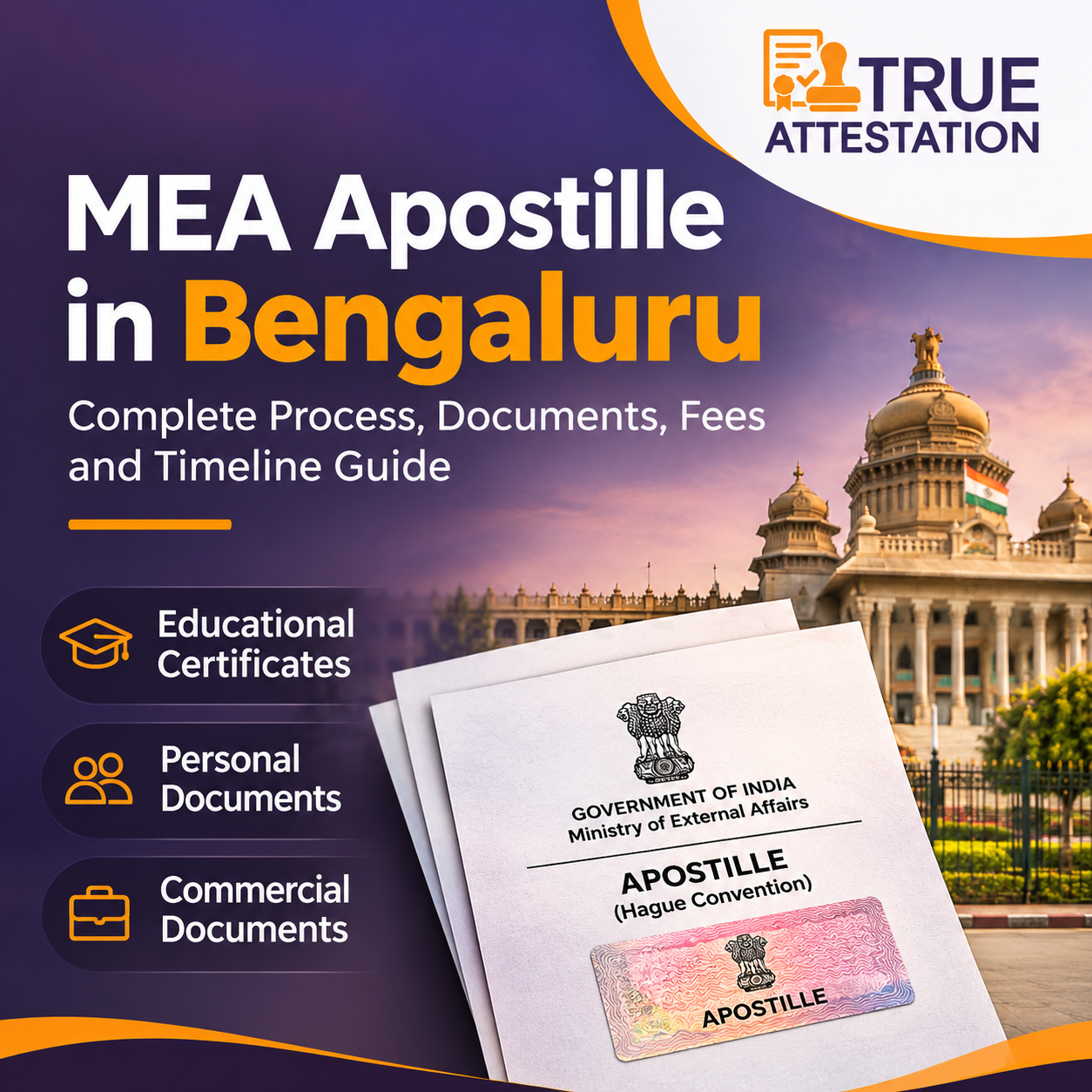
An apostille certificate is an official certificate issued by a designated authority to verify the authenticity of a signature, official seal or stamp on a public document.
It is used to simplify the legalisation of documents between countries that are members of the Hague Apostille Convention, 1961.
India became a member of the Hague Apostille Convention in 2005. The Ministry of External Affairs (MEA), Government of India, is the competent authority responsible for issuing apostille certificates for eligible Indian documents.
For example, imagine that you have completed your degree in India and received an employment opportunity in Germany. Your employer may ask you to submit an apostilled educational certificate to establish that the document carries a properly authenticated official signature or seal.
The apostille certificate helps the receiving authorities verify the origin of your document without requiring the traditional chain of embassy legalisation applicable between non-member countries.
An apostille is generally attached directly to the original document or issued as a separate attached sheet.
Important: An apostille verifies the origin of a document, including the authenticity of the signature, the capacity in which the signatory acted and the identity of the seal or stamp. It does not independently verify whether every statement or qualification mentioned in the document is true.
Why Apostille Is Required for Documents Used Abroad
The main reason behind apostille certification is to make official documents issued in one country acceptable for authentication purposes in another country.
Different countries have different documentation systems, government authorities and verification procedures. A certificate issued by an Indian university or government department may not be immediately verifiable by an organisation located overseas.
Apostille certification provides an internationally recognised method of verifying the origin of eligible public documents.
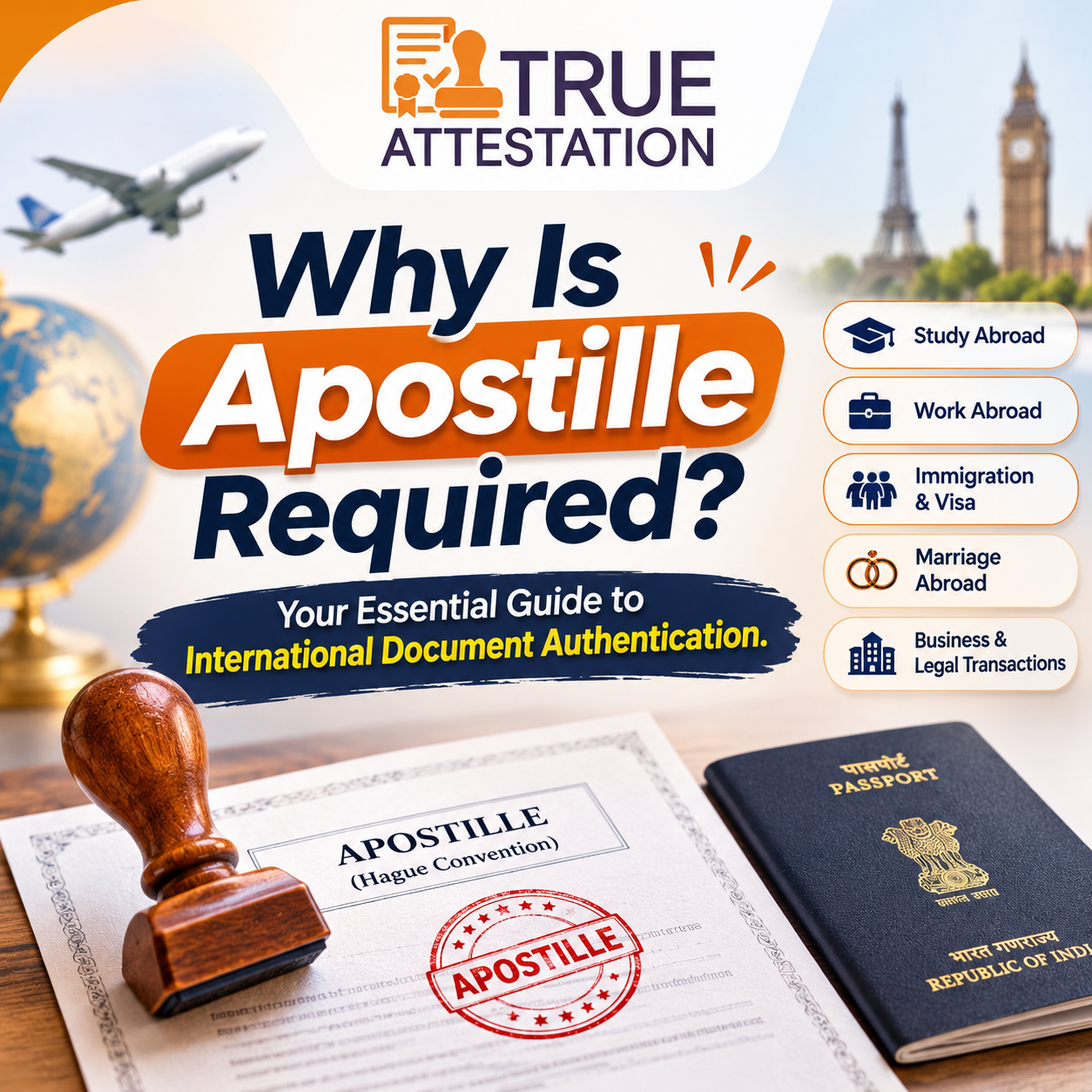
Here are the most common reasons why apostille is required.
-
To Prove the Authenticity of Educational Certificates
Students planning to pursue higher education abroad may be asked to submit authenticated educational documents.
Foreign universities, colleges and educational institutions may request apostille certification for:
- Degree certificates
- Diploma certificates
- Higher secondary certificates
- SSLC and school certificates
- Mark sheets
- Academic transcripts
- Other educational documents, depending on the institution’s requirements
For example, an Indian student applying for a master’s degree in France or Italy may need to provide an apostilled degree certificate as part of the admission or enrolment procedure.
This helps the receiving institution verify the official origin of the submitted educational document.
-
To Meet Overseas Employment Requirements
Getting a job abroad often involves submitting several personal and professional documents to an overseas employer or government authority.
Depending on the destination country and employer, you may be asked for apostilled educational certificates, experience-related documents, birth certificates or other supporting records.
Apostille certification helps establish the authenticity of eligible documents and supports the employer’s document verification process.
For example, an Indian professional applying for a position in a European country may be required to provide an apostilled degree certificate before completing the joining formalities.
-
To Complete Immigration and Visa Formalities
Immigration authorities sometimes request authenticated personal and educational documents during visa applications, residency applications or other immigration procedures.
Documents may include:
- Birth certificates
- Marriage certificates
- Educational certificates
- Police clearance certificates, where applicable
- Affidavits
- Other government-issued records
The requirement depends on the immigration category and the rules of the destination country.
Understanding why apostille is required before submitting immigration documents can help applicants avoid unnecessary delays and document rejections.
-
To Register a Marriage in a Foreign Country
People planning to get married abroad may need to submit personal documents to the local marriage registration authority.
Depending on the country’s regulations, the authorities may request:
- Birth certificates
- Single-status certificates
- Unmarried certificates
- Affidavits
- Divorce decrees, if applicable
- Other personal documents
An apostille may be required to authenticate eligible documents issued in India.
For example, an Indian citizen planning to register a marriage in Spain may be asked to provide an authenticated birth certificate or marital-status document.
Always confirm the exact document requirements with the local marriage registration authority before starting the process.
-
To Handle International Business Transactions
Apostille certification is also important for companies, entrepreneurs and business owners dealing with overseas organisations.
International business transactions often involve official documents that need to be presented to foreign government departments, banks, business partners or legal authorities.
Examples include:
- Company incorporation documents
- Board resolutions
- Power of Attorney
- Business agreements
- Memorandum of Association
- Articles of Association
- Commercial invoices and supporting documents, where applicable
Apostille or the appropriate legalisation process helps authenticate eligible documents for international use.
-
To Submit Power of Attorney Documents Abroad
A Power of Attorney allows one person to authorise another individual to act on their behalf for specific legal or financial matters.
For example, an Indian citizen living in Australia may need to authorise a family member in India to handle property-related matters.
The overseas authority or recipient may request an authenticated Power of Attorney.
Depending on the destination country’s requirements, the document may need notarisation and apostille or another form of consular legalisation.
-
To Complete Property and Financial Transactions
Property transactions and financial matters involving more than one country may require officially authenticated documents.
For example, an Indian citizen living in Germany may need to execute a Power of Attorney to manage property in India, or a person handling overseas inheritance matters may need to submit birth, marriage or other supporting certificates.
Apostille certification can help establish the origin of eligible public documents when they are presented to authorities in another Convention country.’
Which Documents Require Apostille Certification?
The type of document requiring apostille depends on the purpose of use and the requirements of the destination country.
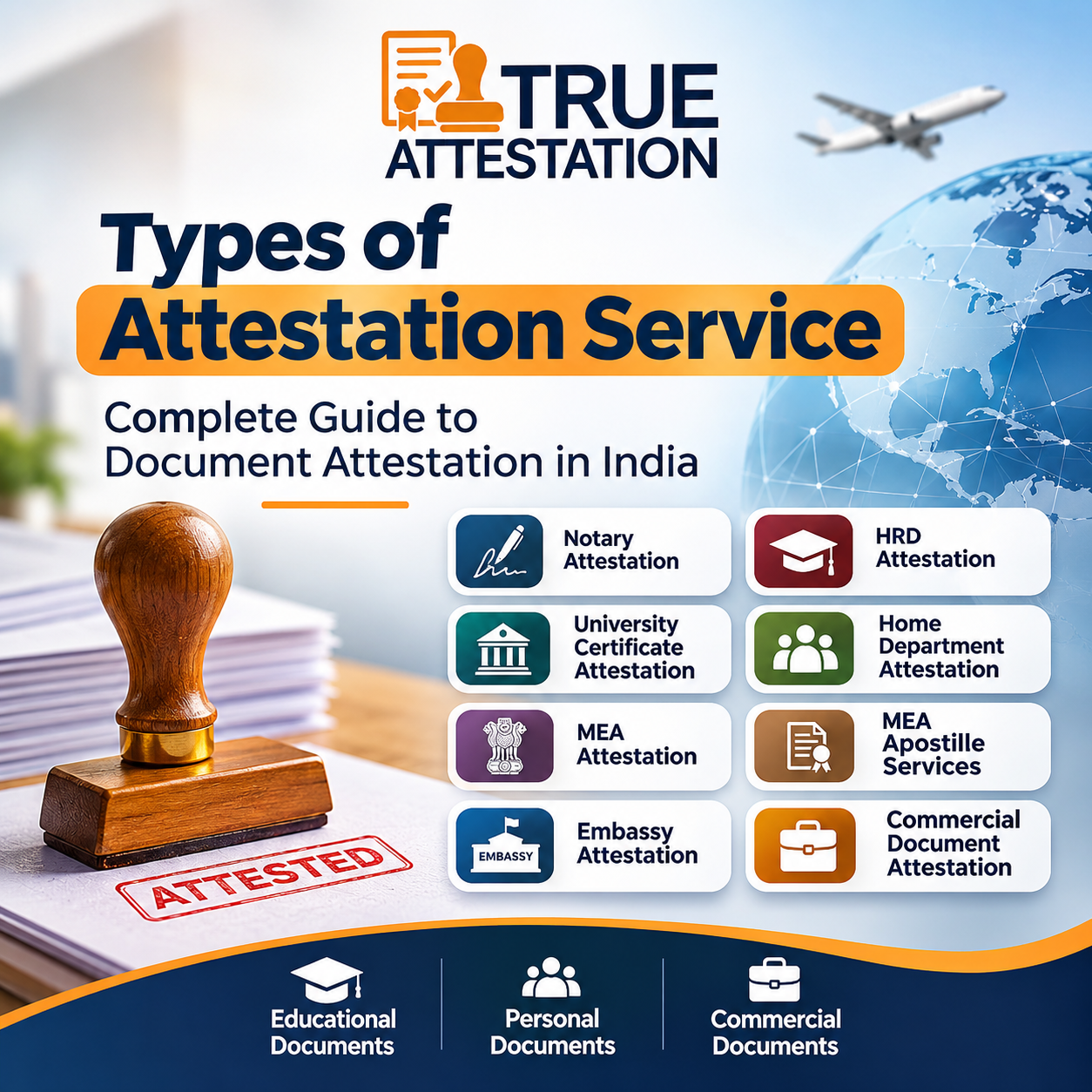
Generally, Indian documents are divided into three major categories.
-
Educational Documents
Educational documents are commonly apostilled for higher education, employment and professional purposes.
Examples include:
- Degree certificates
- Diploma certificates
- SSLC certificates
- PUC certificates
- Mark sheets
- School leaving certificates
- Academic transcripts
-
Personal Documents
Personal documents are generally required for immigration, marriage registration, family visa applications and other personal legal matters.
Examples include:
- Birth certificates
- Marriage certificates
- Death certificates
- Affidavits
- Power of Attorney
- Divorce-related documents
- Other eligible personal certificates
-
Commercial Documents
Commercial documents are required for international business activities, company registration, trade and legal transactions.
Examples include:
- Certificate of Incorporation
- Board resolutions
- Memorandum of Association
- Articles of Association
- Commercial agreements
- Power of Attorney
- Other eligible company documents
The appropriate authentication procedure depends on the document type and the receiving country’s requirements.
How Does Apostille Certification Work in India?
In India, the apostille process involves document verification and authentication before the Ministry of External Affairs issues the apostille certificate.
The exact procedure can vary depending on the type of document and the state or authority that issued it.
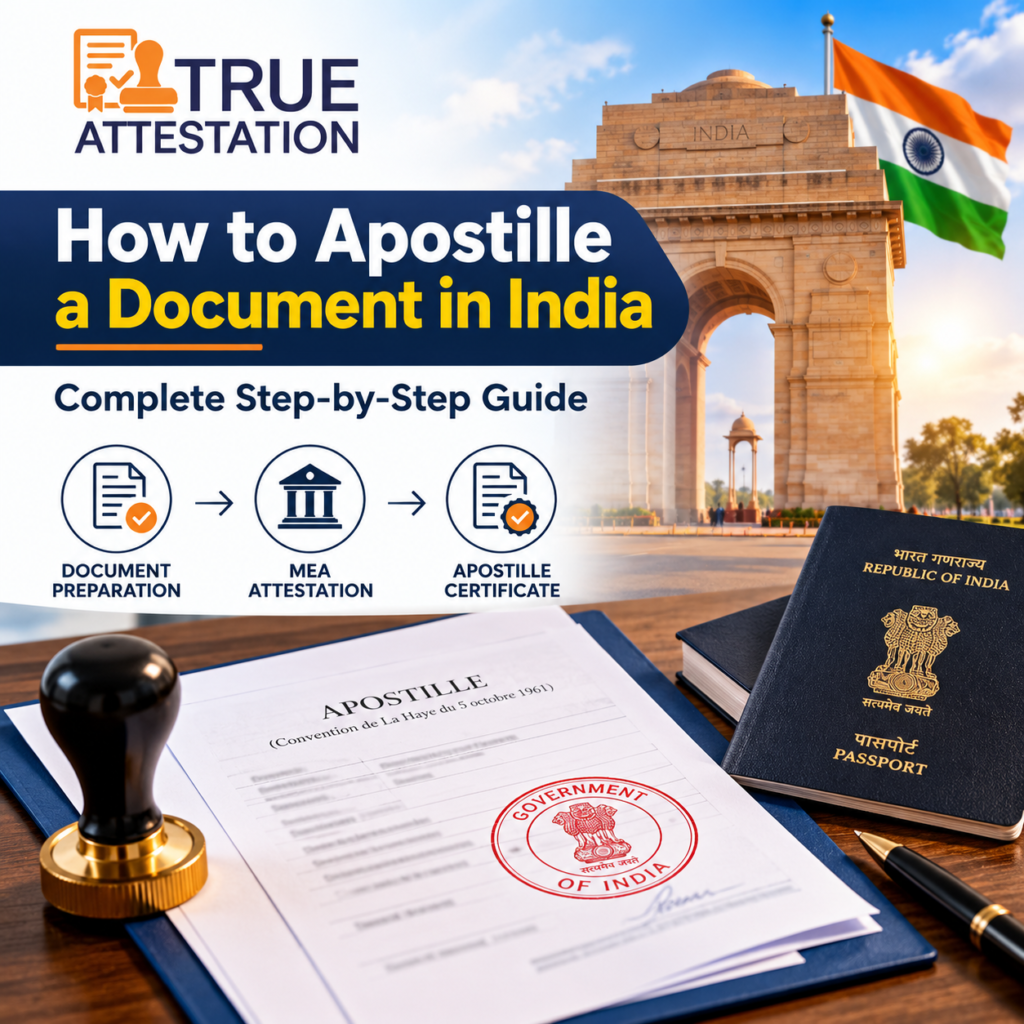
Here is a general step-by-step explanation.
Step 1: Identify the Document and Destination Country
First, identify which document needs apostille certification and the country where it will be submitted.
Different countries and institutions may have different requirements.
Step 2: Complete the Required Pre-Authentication
Before submitting a document for apostille, the relevant issuing or designated state authority may need to verify it.
For example:
- Educational documents may require verification by the appropriate education department or designated authority.
- Personal documents may require authentication by the concerned Home Department or General Administration Department.
- Commercial documents may require authentication through the relevant Chamber of Commerce.
The applicable authority depends on the document category and current government procedure.
Step 3: Submit the Document for MEA Apostille
After the required pre-authentication, the document can be submitted through the applicable Ministry of External Affairs process.
The MEA verifies the authorised signature or seal and issues the apostille certificate when the document meets the requirements.
Step 4: Receive the Apostilled Document
Once the process is completed, the apostilled document is returned to the applicant.
Before submitting it overseas, check that the document and apostille certificate are complete and that the receiving organisation accepts the format provided.
Apostille vs Normal Attestation: What Is the Difference?
One common misunderstanding is that apostille and normal attestation are the same. Although both processes authenticate documents for international use, their application is different.
| Apostille Certification | Normal Attestation |
| Used for eligible documents intended for Hague Apostille Convention countries. | Used for countries where apostille is not accepted. |
| Issued by the designated competent authority. | Involves the applicable government and consular legalisation procedure. |
| Simplifies the traditional legalisation process. | May require additional embassy or consulate authentication. |
| Generally uses a standard apostille certificate. | Follows the destination country’s prescribed attestation requirements. |
For example, countries such as France, Germany and Italy recognise apostilles under the Convention.
However, the UAE, Kuwait and Qatar are not included in India’s current MEA list of Apostille Convention countries. Documents intended for these destinations generally require the applicable attestation and embassy legalisation process rather than apostille.
Always check the latest Convention status and destination-country requirements before choosing a service.

Is Apostille Mandatory for Every Document?
No. Apostille is not compulsory for every document or every international application.
It is generally required when:
- The document is issued in a country that is a party to the Hague Apostille Convention.
- The destination country is also a party to the Convention.
- The document is covered by the Convention.
- The receiving authority requires apostille or does not provide an exemption.
Some countries, institutions and legal procedures may have different requirements. In certain cases, apostille may not be necessary because of specific agreements, exemptions or simplified procedures.
Therefore, it is always advisable to confirm the requirement with the university, employer, embassy, immigration authority or organisation receiving your document.
What Happens If You Submit a Document Without Apostille?
If an apostille is specifically required and you submit the document without it, the receiving organisation may refuse to accept the document or request additional authentication.
This can lead to:
- Delays in university admission.
- Postponement of employment joining dates.
- Delays in visa or residency procedures.
- Problems with marriage registration.
- Delays in business or legal transactions.
- Additional documentation expenses.
Completing the required authentication process before submission can help avoid these complications.
Why Choose a Professional Apostille Service?
Although government authorities issue apostille certificates, applicants may find the process confusing because different documents require different pre-authentication procedures.
A professional apostille service provider can help applicants understand the documentation requirements and coordinate the process.
Here are some benefits of choosing professional assistance:
Document Guidance: Get information about the applicable authentication requirements for educational, personal and commercial documents.
Process Support: Understand the different stages involved in state-level verification and MEA apostille.
Reduced Documentation Errors: Proper document checking can help identify common issues before submission.
Time Management: Professional coordination can make the documentation process more convenient.
Application Assistance: Get support with submitting and collecting documents through the applicable authorised channels.
However, applicants should remember that the final approval and issuance of apostille certificates remain with the competent government authority. No private service provider can guarantee government approval.
Get Reliable Apostille Assistance from True Attestation
If you are planning to study, work, settle or conduct business abroad, completing your document authentication correctly is an important step.
True Attestation provides assistance with document attestation and apostille-related requirements for individuals and businesses in Bangalore.
Whether you need educational certificate apostille, personal document authentication, commercial document attestation or guidance on overseas documentation, our team can help you understand the applicable procedure.
We assist with documentation requirements for:
- Educational certificate apostille
- Birth and marriage certificate authentication
- Affidavit and Power of Attorney attestation
- Commercial document attestation
- MEA apostille assistance
- Embassy attestation requirements
Our aim is to make international document authentication easier to understand and more convenient for applicants.

True Attestation
Phone: +91-9380152536
Email: info@Trueattestation.com
Website: www.trueattestation.com
Visit: No 39/4, 1st Floor, Behind Dominos Pizza, E Anjaneya Temple Street, Bull Temple Road, Gandhi Bazaar, Basavanagudi, Bangalore, Karnataka – 560004
Get in touch with our team to understand the document requirements for your destination country.
Frequently Asked Questions About Why Apostille Is Required
-
Why apostille is required for Indian documents?
Apostille is required to authenticate the origin of eligible Indian public documents when they need to be presented in another country that recognises the Hague Apostille Convention. It helps foreign authorities verify official signatures and seals.
-
Who issues apostille certificates in India?
The Ministry of External Affairs (MEA), Government of India, is the competent authority responsible for issuing apostille certificates for eligible Indian documents.
-
Is apostille required for studying abroad?
It depends on the destination country and the university’s requirements. Some universities request apostilled degree certificates, transcripts or other educational documents during admission and enrolment.
-
Is apostille required for a birth certificate?
A birth certificate may require apostille when it is submitted abroad for immigration, marriage registration, residency or other official purposes in a Convention country. The receiving authority determines the exact requirement.
-
How long does apostille take in India?
The processing time depends on document verification, pre-authentication, document category and submission method. The Ministry of External Affairs’ published Citizen’s Charter indicates a usual processing period of seven working days after receipt by MEA, subject to the applicable process. Additional time may be needed for preliminary verification and delivery.
-
Can I get an apostille without the original certificate?
Requirements depend on the document category and the applicable government procedure. Original documents or eligible verified copies may be required. Confirm the requirements before submitting your application.
-
Is apostille valid in all foreign countries?
No. Apostille is applicable between countries covered by the Hague Apostille Convention, subject to the Convention’s scope and applicable requirements. Countries that do not accept apostille generally require normal attestation and consular legalisation.
-
Is apostille the same as embassy attestation?
No. Apostille is a simplified authentication process for Convention countries. Embassy attestation or consular legalisation is generally required for countries where apostille is not accepted.
-
Does apostille confirm that the information in my certificate is correct?
No. Apostille verifies the origin of the document, including the authenticity of the signature and seal. It does not certify the truth or accuracy of the information written in the document.
-
Can I get apostille services in Bangalore?
Yes. Applicants in Bangalore can seek professional assistance with document verification requirements, pre-authentication and MEA apostille procedures through a document attestation service provider.
Conclusion
Understanding why apostille is required is important for anyone planning international education, employment, immigration, marriage registration or business activities.
Apostille certification simplifies the authentication of eligible public documents between countries that are members of the Hague Apostille Convention. It helps receiving authorities verify the origin of documents and reduces the need for traditional embassy legalisation.
However, the correct procedure depends on the document category, destination country and purpose of submission.
Before sending your documents abroad, check the requirements carefully and complete the necessary authentication steps.
For reliable guidance and assistance with apostille and attestation requirements in Bangalore, contact True Attestation and make your international documentation process easier.
Our services:
Official references for factual accuracy
The article follows the relevant Indian government and international guidelines: