


Types of Attestation Service: Understand Every Document Authentication Process.
Document attestation is an essential procedure for individuals and businesses planning to use Indian documents internationally. Whether you are applying for overseas employment, higher education, family immigration, or international business opportunities, foreign authorities may require officially authenticated documents.
Understanding the Types of Attestation Service helps applicants avoid unnecessary delays, incorrect verification procedures, and document rejection. Different countries follow different authentication requirements depending on their legal systems and international agreements.
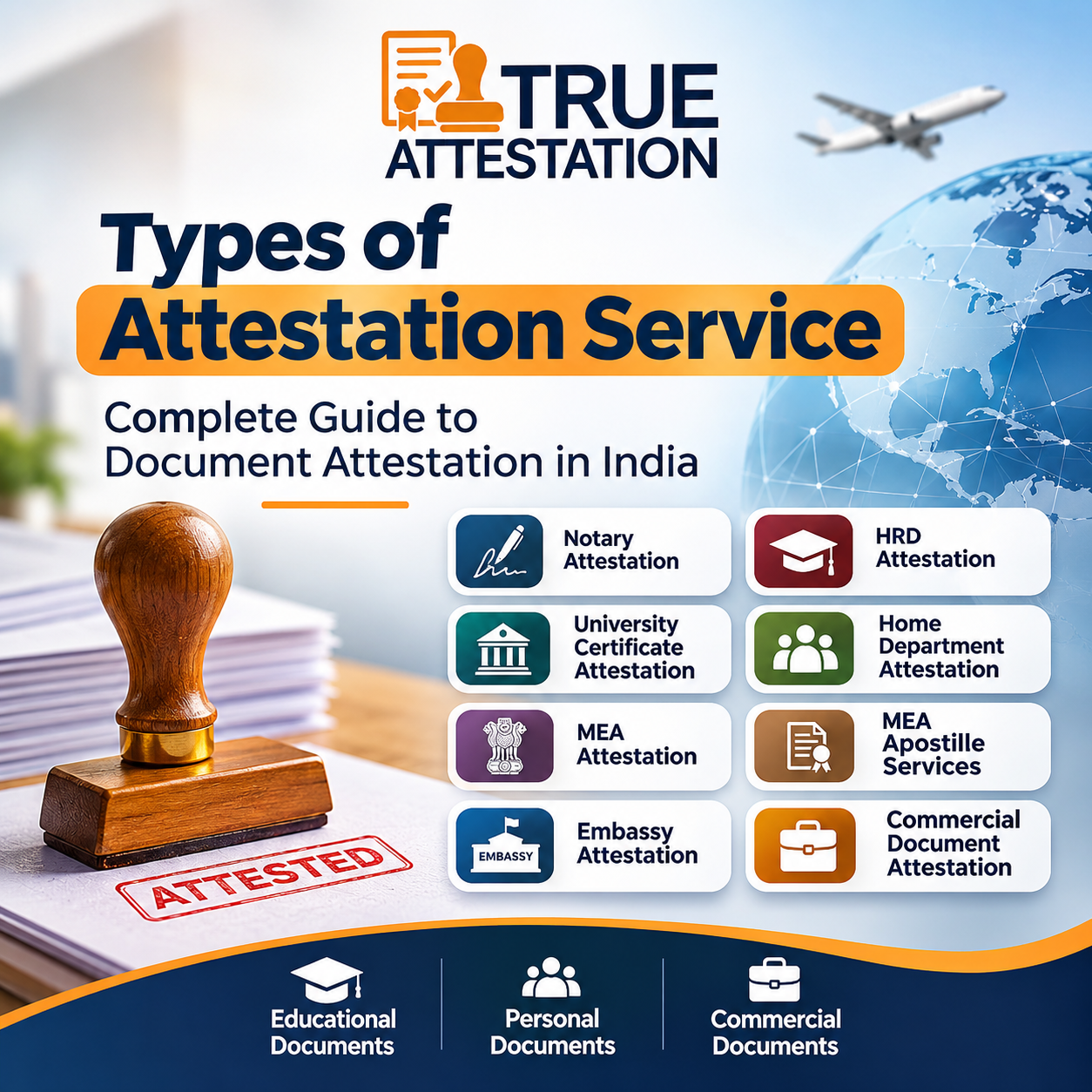
The Types of Attestation Service available in India include notary authentication, HRD verification, university authentication, Home Department attestation, Ministry of External Affairs attestation, apostille, and embassy legalization.
Professional Document Attestation Services in India help applicants identify the appropriate process based on their document category, destination country, and purpose of submission.
What Is Document Attestation?
Document attestation is the official process of verifying a document’s authenticity through designated authorities. It generally involves confirming signatures, seals, or the official capacity of the person who issued or authenticated the document.
Foreign governments, universities, employers, and immigration departments request authenticated documents to establish their legitimacy.
Certificate Attestation is commonly required for employment visas, university admissions, dependent visas, professional licensing, and international commercial transactions.
Attestation and apostille are different authentication methods. An apostille is a standardized certificate issued under the Hague Apostille Convention. Conventional legalization may involve additional authentication by the destination country’s embassy or consulate.
Neither process automatically guarantees acceptance. The receiving authority determines its documentary requirements.
Different Types of Attestation Service Available in India
India offers several authentication procedures depending on the nature of the document and the country where it will be submitted.
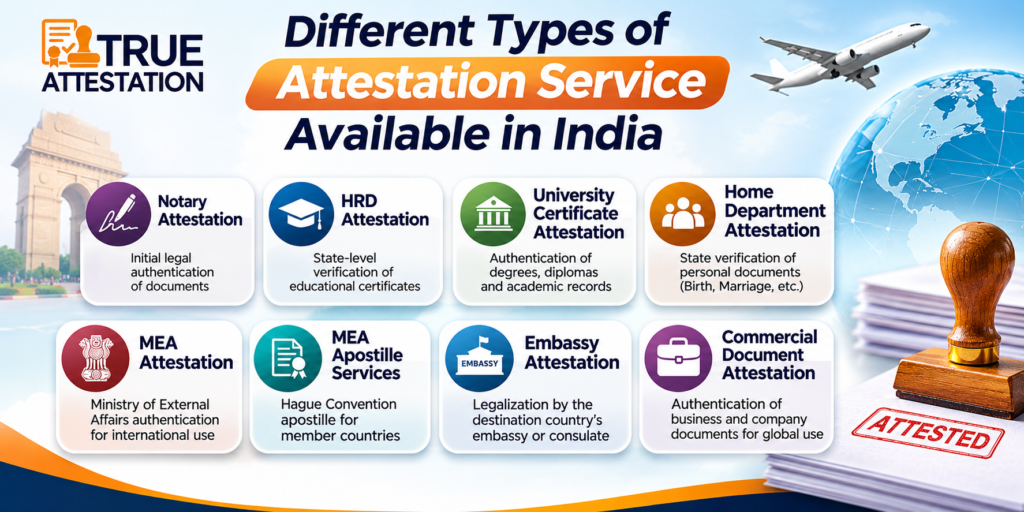
The following table summarizes the major Types of Attestation Service and their common applications.
| Attestation method | Main purpose | Common documents |
| Notary | Notarial authentication | Affidavits, declarations |
| HRD | State educational authentication | Degrees, diplomas |
| University | Academic record verification | Degrees, transcripts |
| Home Department | State authentication of personal records | Birth, marriage certificates |
| MEA | Central authentication | Educational, personal, commercial |
| Apostille | Hague Convention authentication | Eligible public documents |
| Embassy | Destination-country legalization | Various certificates |
| Commercial | Business document authentication | Agreements, invoices |
-
Notary Attestation: Types of Attestation Service for Initial Verification
Notary Attestation involves a legally appointed notary public performing permitted notarial acts, such as witnessing signatures, authenticating declarations, or certifying document copies.
Common documents include affidavits, authorization letters, declarations, and powers of attorney.
A notary may verify the identity of a signatory and apply an official seal when appropriate.
Notarization is not automatically mandatory for every international document. Its necessity depends on the document, the applicable authentication route, and the receiving authority’s instructions.
-
HRD Attestation: Types of Attestation Service for Educational Certificates
HRD Attestation generally refers to educational document authentication conducted through the designated state education department or competent state authority.
It is associated with Educational Certificate Attestation for degrees, diplomas, and other academic qualifications.
Applicants pursuing Attestation for Higher Education Abroad or overseas employment may encounter state educational verification requirements.
Procedures differ across states. Some authorities require confirmation from the issuing university, while others follow separate verification arrangements.
HRD authentication is not universally mandatory for every educational document or apostille application.
-
University Certificate Attestation: Types of Attestation Service for Academic Verification
University Certificate Verification establishes whether an academic document was genuinely issued by the institution concerned.
It may cover degree certificates, provisional certificates, diplomas, mark sheets, and transcripts.
During Degree Certificate Attestation, universities may verify registration details, examination records, academic qualifications, or authorized signatures.
Certain institutions provide online verification facilities, while others require applications through designated departments.
University verification is particularly useful when employers, universities, licensing bodies, or authentication authorities request confirmation of academic credentials.
-
Home Department Attestation: Types of Attestation Service for Personal Documents
Home Department Attestation involves authentication of eligible personal documents through the competent state authority.
Common examples include birth certificates, marriage certificates, and certain declarations or personal records.
Birth Certificate Attestation may be necessary for dependent visa applications, overseas schooling, or immigration procedures.
Marriage Certificate Attestation is frequently requested for spouse visas, family residence applications, and related legal formalities.
The competent authority and verification route vary according to the document’s issuing state and applicable requirements.
-
MEA Attestation: Types of Attestation Service for International Authentication
MEA Attestation Services involve authentication performed by India’s Ministry of External Affairs.
The ministry authenticates eligible documents through prescribed procedures, generally following verification by the appropriate designated authorities or authorized channels.
MEA authentication can apply to educational, personal, and commercial documents.
Its purpose is to authenticate relevant official signatures or seals for international use.
However, MEA attestation does not independently verify every statement contained within a certificate.
Applicants should confirm whether the destination country requires conventional attestation, an apostille, or additional embassy legalization.
-
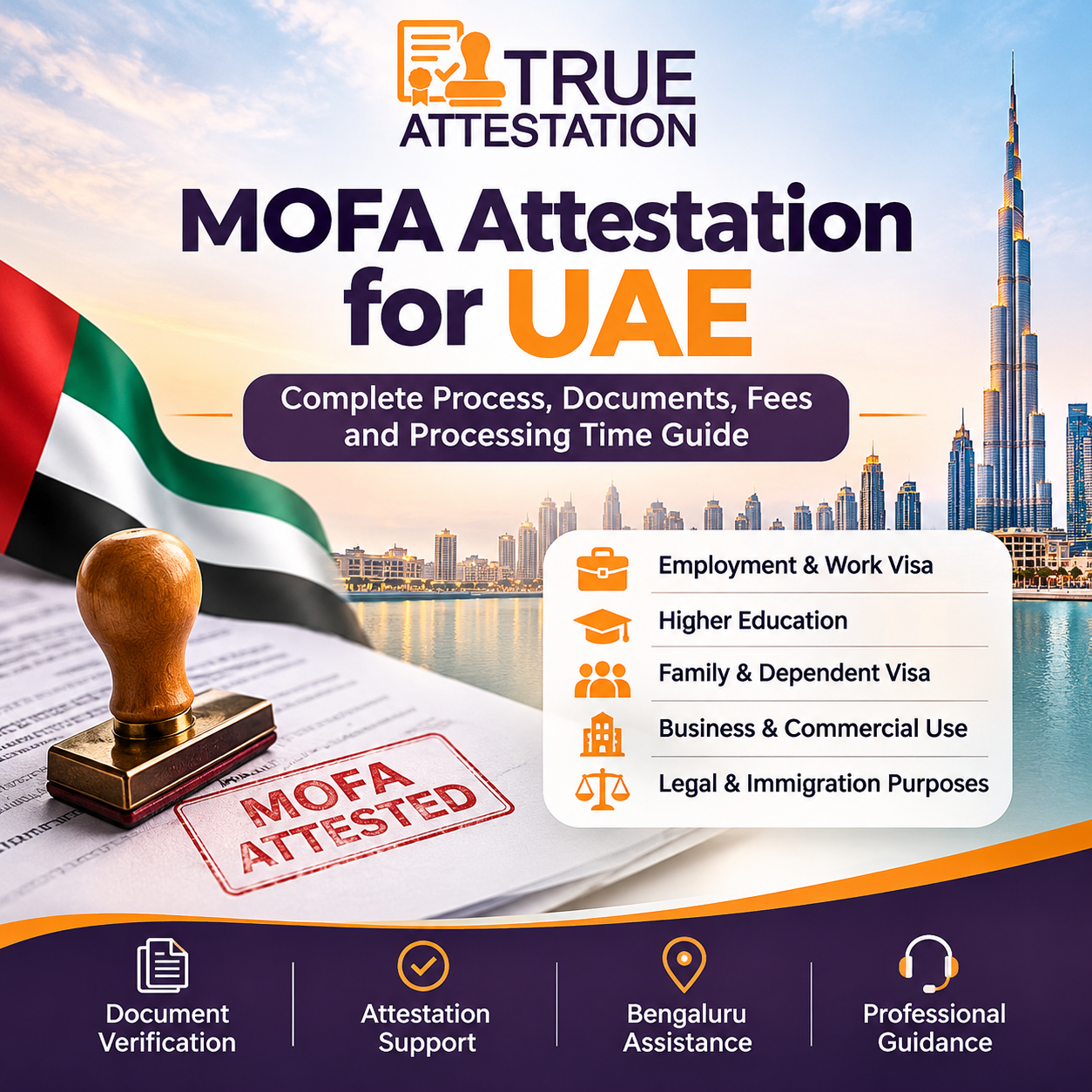
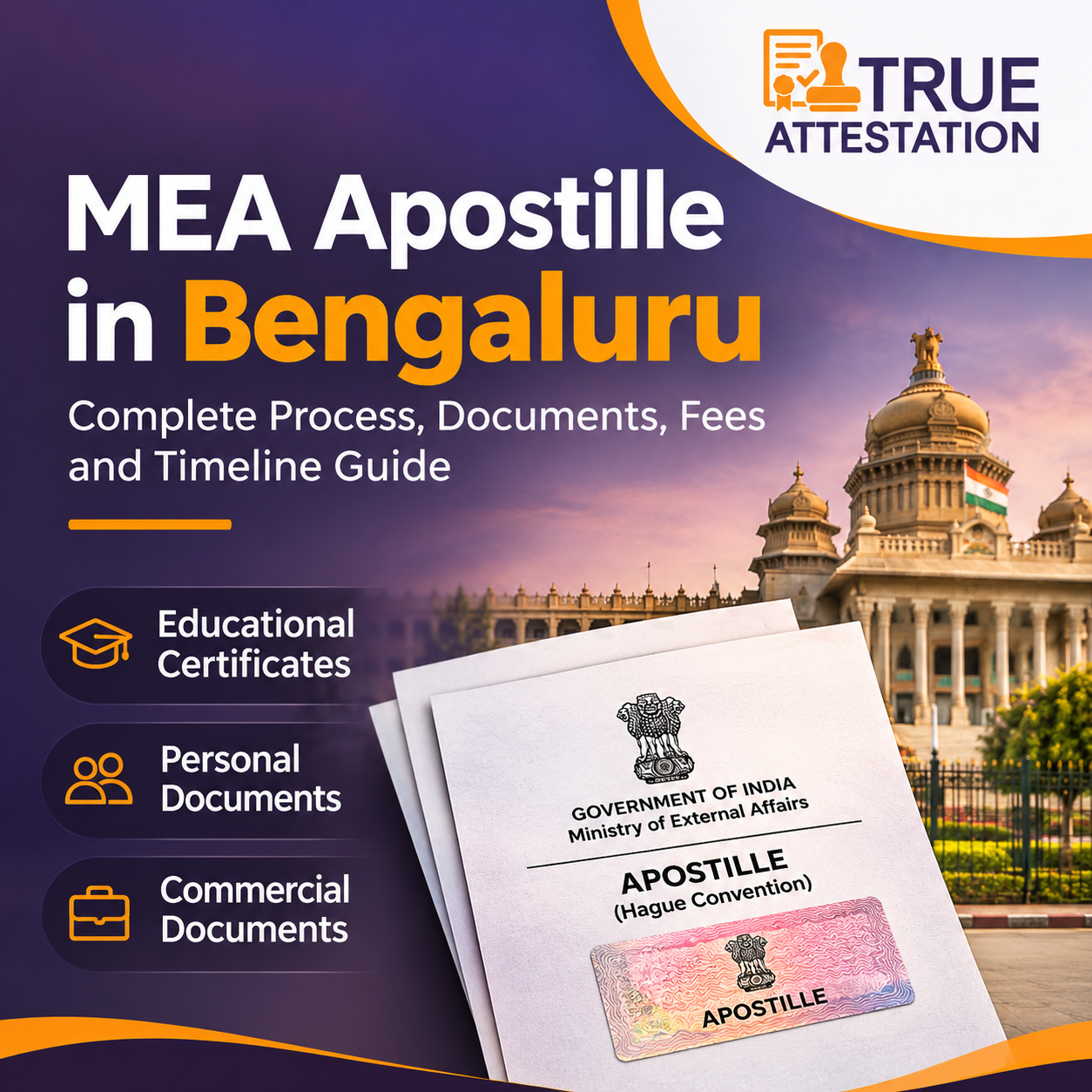
MEA Apostille Services: Types of Attestation Service for Hague Convention Countries
MEA Apostille Services provide standardized authentication under the Hague Convention of 5 October 1961.
An apostille authenticates the origin of an eligible public document, including the signature, official capacity, or seal associated with it.
India issues apostilles through the Ministry of External Affairs using its prescribed procedures.
Apostilles are generally recognized among participating Convention countries without further diplomatic legalization, subject to the document’s eligibility and the receiving authority’s requirements.
An apostille does not certify the truth of the document’s contents.
Applicants should verify whether the destination country recognizes Indian apostilles before proceeding.
-
Embassy Attestation: Types of Attestation Service for Non-Apostille Requirements
Embassy Attestation involves legalization by the embassy or consulate of the country where a document will be used.
This procedure may be required when the destination country does not recognize the applicable apostille arrangement or specifically requests consular legalization.
Educational qualifications, personal certificates, and commercial records may require embassy authentication.
Requirements differ between diplomatic missions. Some request prior MEA authentication, specific translations, application forms, or supporting identification.
Applicants should always follow current instructions from the relevant embassy and receiving institution.
-
Commercial Document Attestation: Types of Attestation Service for International Business
Commercial Document Attestation supports companies conducting international transactions, establishing overseas operations, or entering foreign business agreements.
Documents commonly include certificates of incorporation, commercial invoices, powers of attorney, board resolutions, and business contracts.
Authentication requirements depend on the destination country, document purpose, and applicable commercial regulations.
Some commercial documents follow procedures involving chambers of commerce, designated authorities, MEA authentication, or consular legalization.
Professional assistance can help businesses identify the appropriate route without assuming that every commercial document requires identical authentication.
Types of Documents That Require Attestation
Understanding document categories is important when comparing the Types of Attestation Service for overseas applications.
| Document category | Examples | Common international purpose |
| Educational | Degrees, diplomas, mark sheets, school certificates, transcripts | Employment, admissions, licensing |
| Personal | Birth, marriage, divorce certificates, affidavits, Police Clearance Certificates | Immigration, dependent visas, family matters |
| Commercial | Incorporation certificates, Memorandum and Articles of Association, agreements, invoices, powers of attorney | Business expansion, trade, legal representation |
Educational documents usually establish academic qualifications. Personal documents establish identity, civil status, or other personal circumstances. Commercial documents support international business and legal transactions.
Not every document requires attestation in every situation. Requirements should be confirmed before submission.
How to Choose the Right Attestation Service?
Selecting the correct Types of Attestation Service depends on several practical factors.
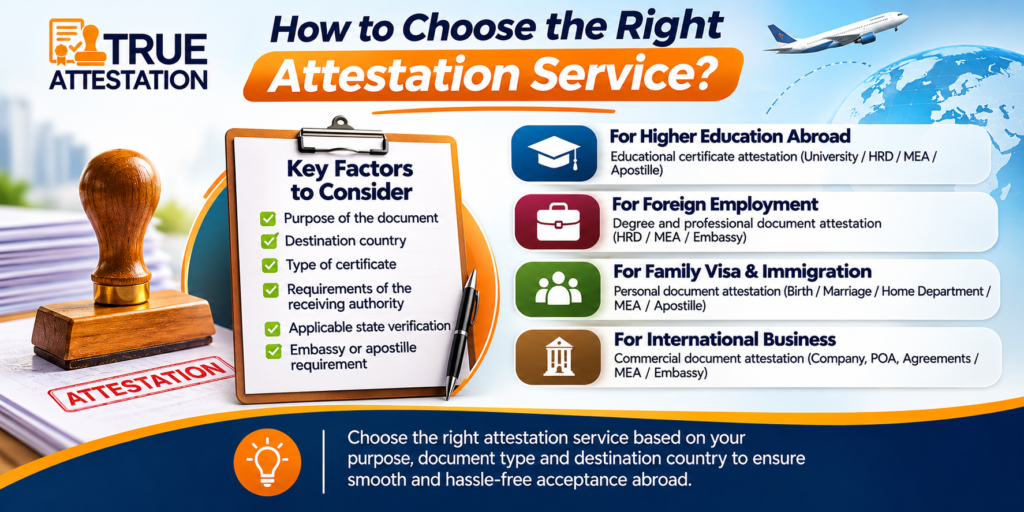
- Purpose: Employment, education, immigration, or business.
- Destination: Whether the country accepts apostilles.
- Document category: Educational, personal, or commercial.
- Receiving authority: Specific authentication instructions.
- Issuing state: Applicable state-level verification.
- Additional requirements: Embassy legalization, translations, or supporting records.
For example, Attestation for Foreign Employment may involve degree verification and destination-specific legalization. A family visa application may require authenticated marriage or birth certificates.
Always obtain current requirements from the requesting organization.
Why Choose Professional Attestation Services?
Professional assistance can simplify document preparation and administrative coordination.
Experienced service providers help applicants understand documentation requirements, identify appropriate authorities, and avoid preventable submission mistakes.
They may also assist with application tracking, document collection, and communication throughout processing.
For applicants handling multiple certificates, professional coordination can reduce administrative effort.
Nevertheless, government verification decisions and processing schedules remain outside a private service provider’s control.
Why Choose True Attestation?
True Attestation provides assistance to individuals, families, professionals, and businesses seeking document authentication for international purposes.
Its services include guidance relating to Educational Certificate Attestation, Personal Document Attestation, Commercial Document Attestation, MEA apostille procedures, and embassy legalization.
Applicants preparing for overseas education, employment, immigration, or business activities can seek help understanding applicable documentation requirements.
True Attestation focuses on helping customers navigate the relevant procedures and prepare documents for submission.
Frequently Asked Questions About Types of Attestation Service
- What are the different types of attestation services available in India?
The major Types of Attestation Service include notary, HRD, university, Home Department, MEA, apostille, embassy, and commercial document authentication. Each serves a different verification purpose.
- What is the difference between MEA attestation and apostille?
MEA attestation is conventional document authentication. An apostille is a standardized authentication certificate recognized under the Hague Apostille Convention. The appropriate method depends on the destination country’s requirements.
- Is HRD attestation mandatory for educational certificates?
No. HRD authentication is not universally compulsory. Requirements depend on the issuing state, verification route, document category, and receiving authority.
- Which documents require embassy attestation?
Educational certificates, personal documents, and commercial records may require embassy legalization when specified by the destination country or receiving organization.
- What is the purpose of notary attestation?
Notary authentication helps establish the authenticity of certain signatures, declarations, or document copies through authorized notarial procedures.
- How long does document attestation take in India?
Processing times vary depending on document verification, government procedures, institutional responses, and embassy requirements. Applicants should confirm estimated timelines before applying.
- Can personal documents be apostilled?
Yes. Eligible personal documents, including birth and marriage certificates, can generally receive an apostille through the prescribed process.
- Is university verification required before MEA attestation?
University verification may be required depending on the educational certificate and applicable authentication procedure. It is not a universal requirement for every application.
- Which attestation is required for employment abroad?
The required Types of Attestation Service depend on the destination country, employer, professional licensing rules, and educational documents being submitted.
- How do I select the correct document attestation service?
Compare the Types of Attestation Service against your document category, destination country, and receiving authority’s instructions. Professional guidance can help clarify the correct procedure.
Conclusion
Understanding the Types of Attestation Service is important for individuals and organizations preparing Indian documents for international use. Educational, personal, and commercial certificates may follow different authentication procedures depending on their purpose and destination.
Choosing correctly can prevent avoidable documentation errors and unnecessary processing delays.
If you need assistance identifying the appropriate Types of Attestation Service, contact True Attestation for guidance on document verification, MEA authentication, apostille procedures, and embassy legalization.
Prepare your documents confidently with professional assistance tailored to your international requirements.
True Attestation
Phone: +91-9380152536
Email: info@Trueattestation.com
Website: www.trueattestation.com
Visit: No 39/4, 1st Floor, Behind Dominos Pizza, E Anjaneya Temple Street, Bull Temple Road, Gandhi Bazaar, Basavanagudi, Bangalore, Karnataka – 560004

Our services: