


Introduction – Why Is MEA Attestation India Important for International Document Verification?
Planning to study, work, settle or expand your business abroad? You may need to submit Indian educational, personal or commercial documents to foreign government departments, universities, employers or other institutions. However, many foreign authorities do not accept documents without proper authentication from the issuing country’s designated authorities MEA Attestation India.
This is where MEA attestation India becomes important. The Ministry of External Affairs (MEA), Government of India, provides document authentication services for Indian documents intended for international use. Depending on the destination country, applicants may require normal MEA attestation or an apostille certificate.
For example, a student travelling abroad for higher education may need an authenticated degree certificate. Similarly, someone accepting an overseas employment opportunity may need educational certificates, birth certificates or other supporting documents authenticated.
Understanding the correct procedure helps applicants avoid unnecessary delays, additional expenses and document rejection. This guide explains the complete MEA attestation process, document requirements, fees, processing considerations and the assistance available through True Attestation in Bangalore.
What Is MEA Attestation?
MEA attestation is the process through which India’s Ministry of External Affairs authenticates the signature and seal of an authorised government official or designated authority on a document intended for use abroad.
The Ministry provides two important authentication services:
- Normal Attestation: Used for documents intended for countries where apostille is not applicable or accepted.
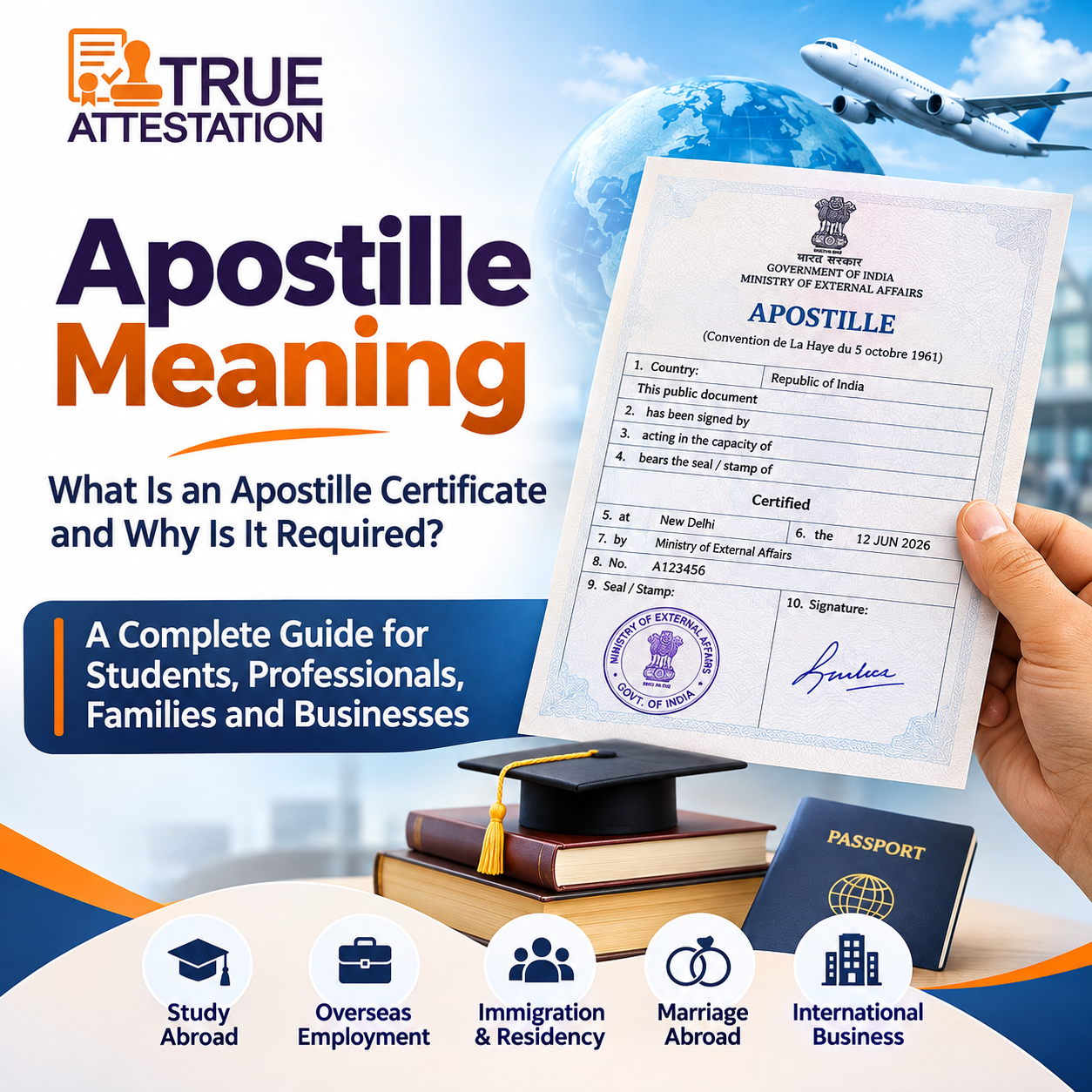
- Apostille: Used for eligible public documents intended for countries where the Hague Apostille Convention applies.
The purpose of Ministry of External Affairs attestation is to establish the authenticity of the authorised signature or seal appearing on the document.
For instance, when an Indian educational certificate is authenticated by the appropriate state education authority, the MEA authenticates the signature of the authorised official.
It is important to understand that MEA authentication does not independently certify the truth of every statement in a document. It authenticates the relevant signature and seal.
Document verification and document attestation are different. Verification checks the document against issuing records, whereas attestation authenticates the signature or seal of the designated authority.
Therefore, MEA attestation India plays an important role in preparing Indian documents for international administrative and legal purposes.
Why Is MEA Attestation Required?
Foreign authorities may request authenticated Indian documents to establish their official origin and accept them for specific international purposes.
Some common situations include:
- Overseas employment: Employers may request authenticated degree certificates, diplomas and professional qualifications before confirming an employee’s eligibility.
- Higher education abroad: Universities may require authenticated educational certificates and marksheets during admission or enrolment.
- Family and dependent visas: Birth and marriage certificates may need authentication to establish family relationships.
- Immigration and permanent residency: Applicants may need authenticated personal, educational and civil documents.
- Marriage registration abroad: Foreign authorities may request birth certificates, affidavits or unmarried-status declarations.
- Business expansion: Companies may need authenticated incorporation certificates, board resolutions and powers of attorney for overseas operations.
- International legal procedures: Affidavits and legal declarations may require authentication before submission to foreign courts or government departments.
- Overseas property and financial matters: Property transactions, banking arrangements and legal authorisations may involve authenticated documents.
The requirements vary depending on the country, document category and purpose of submission.
Types of Documents That Require MEA Attestation India
Different documents follow different authentication procedures. Understanding the document category is the first step.
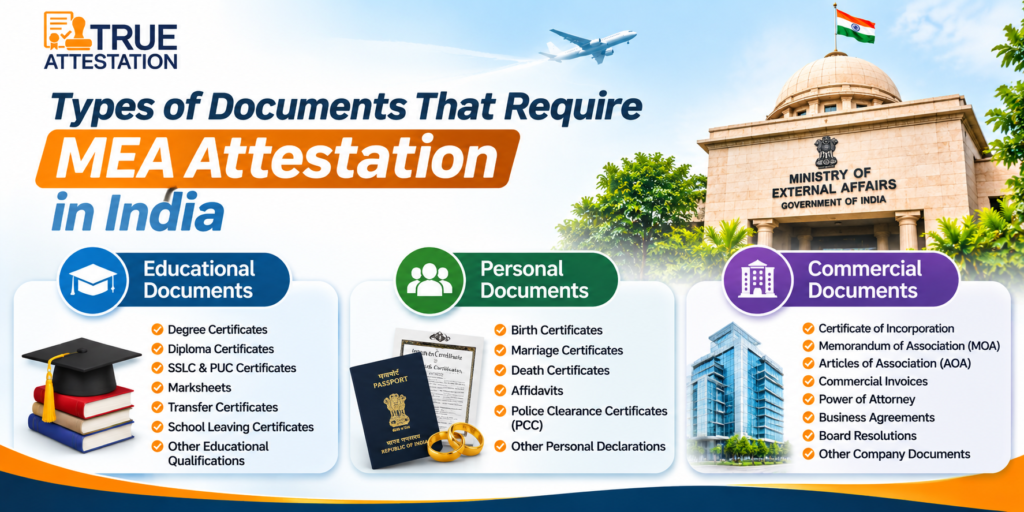
Educational Documents
Students and working professionals commonly require educational certificate authentication for overseas education, employment and professional registration.
Examples include:
- Degree certificates.
- Diploma certificates.
- SSLC and PUC certificates.
- School and college marksheets.
- Transfer certificates.
- School leaving certificates.
- Technical and professional qualification certificates.
MEA attestation for educational certificates generally requires authentication by the designated State Education Department or other authorised authority before MEA processing.
For example, a graduate from Karnataka may need to complete the applicable educational certificate authentication process before submitting the document for central authentication.
Personal Documents
Personal documents establish identity, family relationships and civil status.
Common examples include:
- Birth certificates.
- Marriage certificates.
- Death certificates.
- Affidavits.
- Police Clearance Certificates (PCC).
- Unmarried-status declarations.
- Other personal declarations.
Depending on the document, authentication may be required from the State Home Department, General Administration Department or another designated authority.
Commercial Documents
Businesses may need authenticated documents for international trade, company registration, legal representation and overseas expansion.
Examples include:
- Certificate of Incorporation.
- Memorandum of Association (MOA).
- Articles of Association (AOA).
- Commercial invoices.
- Power of Attorney.
- Business agreements.
- Board resolutions.
Commercial documents generally require prior authentication from the appropriate Chamber of Commerce or other designated authority.
The procedure differs according to the document type and destination country. Applicants should confirm the applicable requirements before submission.
MEA Attestation Process in India: Step-by-Step Guide
The authentication process usually involves preliminary verification, central MEA authentication and additional legalisation where required.
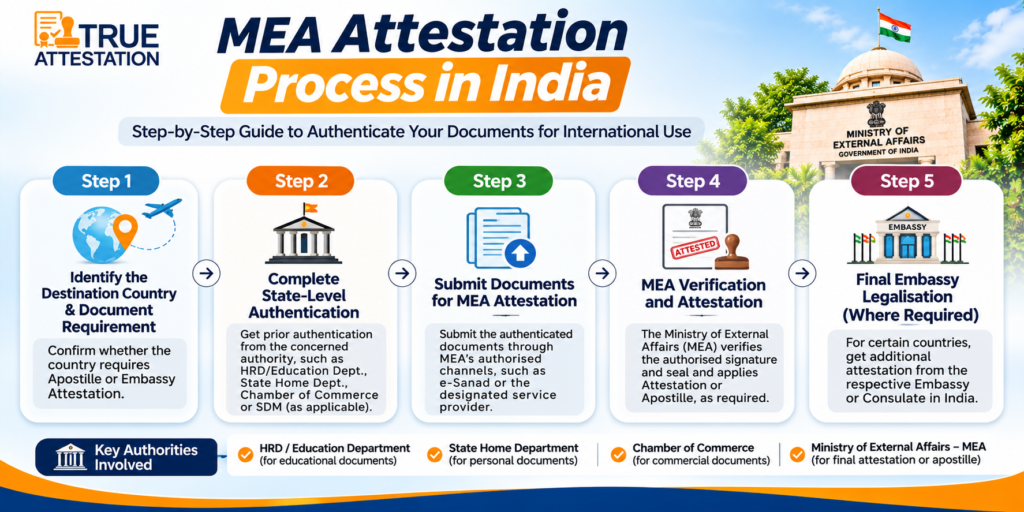
Step 1 – Identify the Destination Country and Document Requirement
First, identify where the document will be submitted and why it is required.
The destination country determines whether apostille or normal attestation is appropriate.
- Countries covered by the applicable Hague Convention arrangements generally accept apostille for eligible documents.
- Other countries may require normal MEA attestation followed by embassy or consular legalisation.
For example, applicants travelling to the UAE for employment should confirm the current requirements of their employer and relevant UAE authorities.
Choosing the correct authentication route before starting is important.
Step 2 – Complete State-Level Authentication
Many documents require authentication from a designated state authority before MEA submission.
The authority depends on the document category.
| Document type | Common authentication authority |
| Educational certificates | State Education or HRD authority |
| Birth and marriage certificates | State Home Department or designated authority |
| Other personal documents | Home or General Administration Department, as applicable |
| Commercial documents | Relevant Chamber of Commerce |
| Eligible documents | SDM, where accepted under applicable procedures |
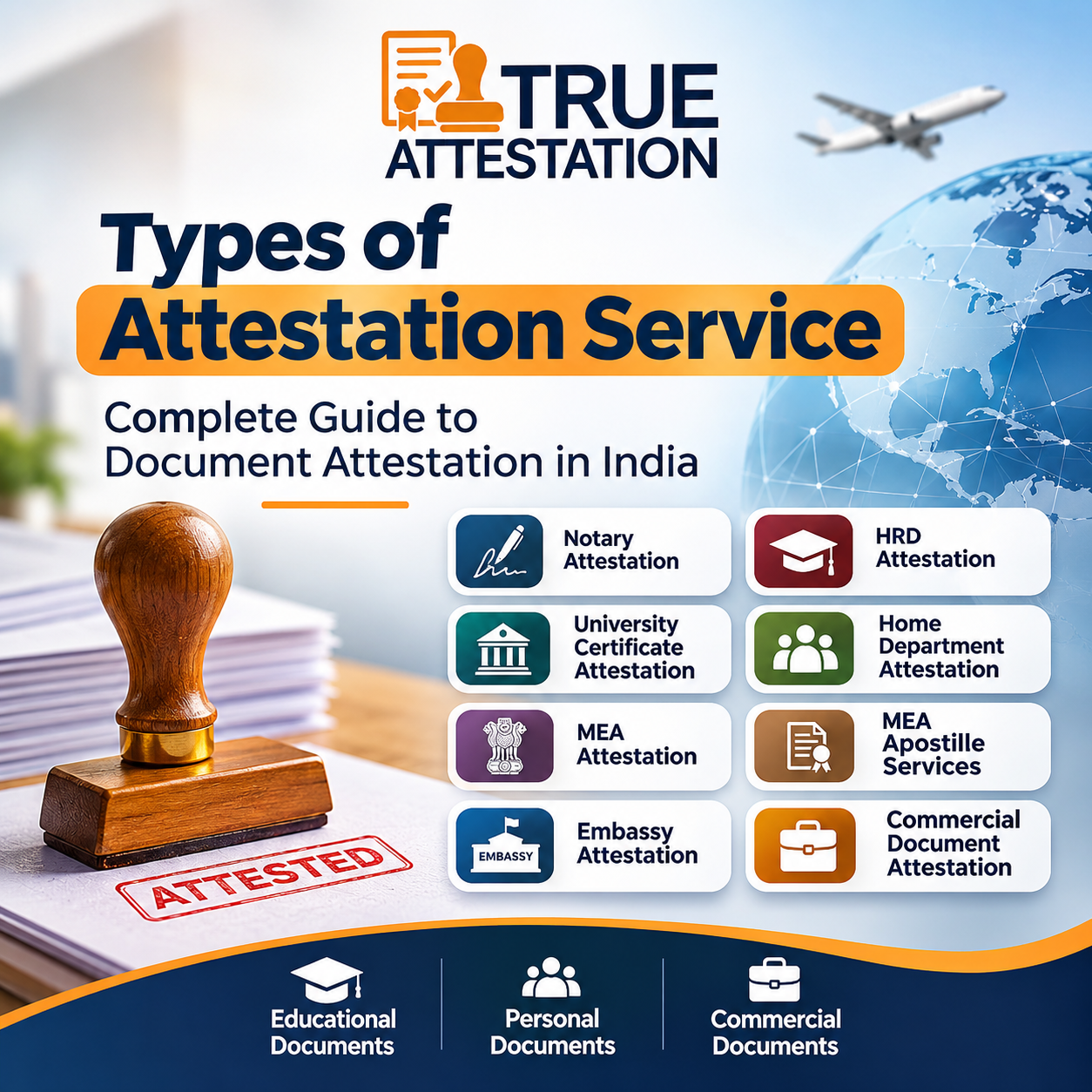
HRD attestation is commonly associated with educational certificates. The relevant authority may verify the certificate with the issuing university, board or institution.
Personal documents may require State Home Department authentication.
SDM authentication is another route available for certain eligible documents, subject to applicable MEA procedures and receiving-country requirements. It should not be treated as a universal replacement for state authentication.
Step 3 – Submit Documents for MEA Attestation
After completing preliminary authentication, applicants must submit their documents through the applicable authorised channel.
The MEA has decentralised attestation and apostille services through designated Branch Secretariats and Regional Passport Offices in several cities, including Bengaluru.
Depending on document eligibility, applicants may use the e-Sanad platform or the designated outsourced service provider channel.
The original certificate, photocopies and applicant identification details should be prepared according to current submission instructions.
Step 4 – MEA Verification and Attestation
At this stage, the MEA authenticates the signature of the designated authority that previously authenticated the document.
Depending on the destination country’s requirements, normal attestation or apostille is issued.
An apostille is provided in the prescribed format and is attached to the eligible document.
This is the central authentication stage of MEA attestation India and must follow the appropriate preliminary verification procedure.
Step 5 – Final Embassy Legalisation Where Required
Some countries require an additional authentication from their embassy or consulate after MEA authentication.
This is known as embassy attestation or consular legalisation.
For example, certain documents intended for employment or commercial purposes in the UAE may require additional legalisation, depending on the document and receiving authority.
Not every country requires this additional step. Applicants should verify the complete procedure before submitting their certificates.
Difference Between MEA Attestation and MEA Apostille
Although both services authenticate documents for international use, they follow different legalisation requirements.
| Particulars | Normal MEA Attestation | MEA Apostille |
| Meaning | MEA authentication of an authorised signature | Authentication through apostille |
| Purpose | For applicable non-apostille destinations | For eligible Convention destinations |
| Countries | Countries where apostille is not applicable | Countries where Convention is in force |
| Authentication | MEA attestation | Apostille certificate |
| Legal framework | Destination-country legalisation requirements | Hague Apostille Convention |
| Further embassy legalisation | Required when the destination country asks for it | Generally not required between applicable Convention countries |
What Is the Hague Apostille Convention?
The Hague Convention of 5 October 1961 abolished the traditional requirement of legalisation for eligible public documents exchanged between participating countries.
India joined the Convention in 2004, and it entered into force for India on 14 July 2005.
An apostille replaces the traditional chain of diplomatic or consular legalisation for documents covered by the Convention.
However, applicants must confirm whether the Convention is in force between India and the destination country. An apostille also does not remove other requirements imposed by the receiving institution, such as translations or supporting documents.
For further information, visit the HCCH Apostille Convention status table.
Documents Required for MEA Attestation India
The requirements vary depending on the document category and destination country.
Generally, applicants should prepare:
- Original certificate or document.
- Photocopy of the original document, where required.
- Applicant’s identity proof.
- Passport copy, where required.
- Supporting verification documents.
- State-level authentication proof, where applicable.
- Authorisation letter, if a representative submits the document.
- Additional documents requested by the relevant authority.
| Document category | Supporting requirements |
| Educational | Original degree, marksheets and verification records |
| Personal | Original birth or marriage certificate and identity proof |
| Commercial | Original business documents and relevant authentication |
| Representative submission | Authorisation letter and applicable identification |
Before starting MEA attestation India, confirm whether your document requires verification from the issuing institution, university or designated government department.
How Long Does MEA Attestation Take in India?
Processing time depends on the document category, preliminary verification and destination-country requirements.
Some documents may be processed relatively quickly, while others require additional verification from universities, education boards or government departments.
Important factors include:
- State-level authentication duration.
- University or issuing authority verification.
- MEA submission and processing arrangements.
- Public holidays and incomplete applications.
- Additional embassy legalisation requirements.
The MEA Citizen’s Charter 2025 indicates a usual processing period of seven working days after receipt of documents at MEA. This does not include every preliminary or subsequent stage.
Applicants should plan well before overseas employment joining dates, university admission deadlines and visa appointments.
Common Reasons for MEA Attestation Delays or Rejection
Incorrect documentation can create unnecessary delays.
Common reasons include:
- Incomplete documents: Missing pages or supporting records.
- Name mismatches: Differences between certificates and passport details.
- Unverified educational certificates: Missing university or state-level verification.
- Missing preliminary authentication: Submission without the required state authentication.
- Damaged documents: Unclear seals, signatures or certificate details.
- Incorrect country requirements: Choosing apostille instead of the required embassy legalisation.
- Incomplete applications: Missing identity proof or authorisation letters.
- Unauthorised submission: Using unsuitable or unrecognised submission channels.
To avoid these issues, check all details carefully, confirm the receiving country’s requirements, keep clear copies and use authorised submission channels.
Why Choose True Attestation for MEA Attestation Services in Bangalore?
Preparing documents for international use can involve several departments, verification stages and submission procedures.
True Attestation provides document attestation assistance in Bangalore for students, professionals, families and businesses requiring authentication of Indian documents for overseas purposes.
Services and assistance include:
- Educational certificate authentication guidance.
- Degree and diploma certificate attestation assistance.
- Personal document attestation.
- Birth and marriage certificate authentication.
- Commercial document attestation assistance.
- HRD attestation coordination.
- State-level authentication guidance.
- MEA attestation coordination.
- MEA apostille assistance.
- Embassy attestation guidance.
- Document verification and application preparation.
- Guidance for documents intended for different countries.
Whether you need a degree certificate for employment abroad or a marriage certificate for family immigration, understanding the correct authentication route is essential.
True Attestation helps applicants understand the applicable procedures and prepare their documents for submission.
If you are searching for MEA attestation services in India, always confirm the receiving country’s requirements before beginning the process.
Frequently Asked Questions About MEA Attestation India
- What is MEA attestation India?
It is the authentication of an Indian document by the Ministry of External Affairs for international use. It confirms the relevant authorised signature and seal.
- Why is MEA attestation required?
Foreign universities, employers and government authorities may require authenticated documents for education, employment, immigration and business purposes.
- How can I get MEA attestation India?
Complete the required preliminary authentication, then submit your document through the applicable authorised MEA channel for apostille or normal attestation.
- Is HRD attestation required before MEA attestation?
Many educational certificates require authentication by the designated state education authority before MEA processing. Requirements depend on the document and applicable procedure.
- What is the difference between MEA attestation and apostille?
Normal MEA attestation is used for applicable non-apostille destinations. Apostille is used for eligible documents intended for countries where the Hague Convention applies.
- How long does MEA attestation take?
The MEA Citizen’s Charter 2025 indicates a usual processing period of seven working days after receipt at MEA. Preliminary verification and embassy procedures can take additional time.
- What documents are required for MEA attestation?
Common requirements include original certificates, identity proof, passport copies where applicable, supporting verification documents and state-level authentication.
- Is MEA attestation mandatory for UAE employment?
Requirements depend on the employer, document category and relevant UAE authority. Some documents require MEA authentication followed by UAE embassy and further legalisation.
- Can I get MEA attestation in Bangalore?
Yes. Bengaluru has designated MEA attestation and apostille service arrangements. Applicants can also seek assistance from True Attestation.
- Can someone submit documents on my behalf?
Depending on the submission channel, an authorised representative may submit documents with the required authorisation and identification.
- Is MEA attestation required for educational certificates?
It depends on the destination country and receiving institution. Some require apostille, while others require normal attestation and embassy legalisation.
- Does MEA attestation guarantee acceptance by a foreign authority?
No. It authenticates the relevant signature and seal. The receiving authority may impose additional requirements concerning translations, validity and document format.
Conclusion – Complete Your International Document Authentication with Confidence
International document authentication is an important step when planning overseas education, employment, immigration or business expansion. Understanding MEA attestation India helps applicants identify the correct process, prepare the necessary documents and avoid unnecessary complications.
Whether you need educational, personal or commercial document authentication, always check the destination country’s requirements before starting. Completing state-level verification, MEA authentication and embassy legalisation where applicable can help ensure that your documents follow the required procedure.
Need assistance with MEA attestation in Bangalore?
Contact True Attestation for guidance and assistance with educational certificate attestation, personal document authentication, commercial documents, MEA apostille and embassy legalisation.
Get the right guidance for your international document authentication requirements and prepare your documents with confidence.
True Attestation
Phone: +91-9380152536
Email: info@Trueattestation.com
Website: www.trueattestation.com
Visit: No 39/4, 1st Floor, Behind Dominos Pizza, E Anjaneya Temple Street, Bull Temple Road, Gandhi Bazaar, Basavanagudi, Bangalore, Karnataka – 560004
Our services:
Official references for factual accuracy
The article follows the relevant Indian government and international guidelines: