



Hague Apostille Convention India: Complete Guide to Apostille and Document Legalisation
If you are planning to study abroad, apply for an overseas job, relocate with your family, establish a business in another country, or apply for foreign residency, you may need to authenticate your Indian documents before submitting them to foreign authorities. Understanding Hague Apostille Convention India requirements is essential to ensure your documents are processed through the correct authentication procedure.
International authorities often require proof that an Indian certificate, affidavit, government document or commercial record is genuine. Depending on the destination country, document authentication may involve state-level verification, Ministry of External Affairs (MEA) apostille or embassy legalisation.
The Hague Apostille Convention India procedure follows an internationally recognised authentication system designed to simplify the legalisation of public documents. Instead of requiring multiple rounds of embassy and consular legalisation, eligible documents can receive a standard apostille certificate.
In this guide, we explain the Convention, India’s participation, document categories, apostille requirements, authentication procedures, costs, common mistakes and how applicants can get professional assistance in Bangalore.
What Is the Hague Apostille Convention?
The Hague Apostille Convention is formally known as the Convention of 5 October 1961 Abolishing the Requirement of Legalisation for Foreign Public Documents.
It is an international treaty developed under the Hague Conference on Private International Law (HCCH). Its primary purpose is to simplify the authentication of public documents intended for use in another participating country.
Before the Convention, documents frequently had to pass through multiple authentication stages, including departments of the issuing country, foreign ministries, embassies and consulates. This process could involve considerable paperwork, administrative expenses and delays.
The Convention introduced a simplified authentication mechanism called an apostille.
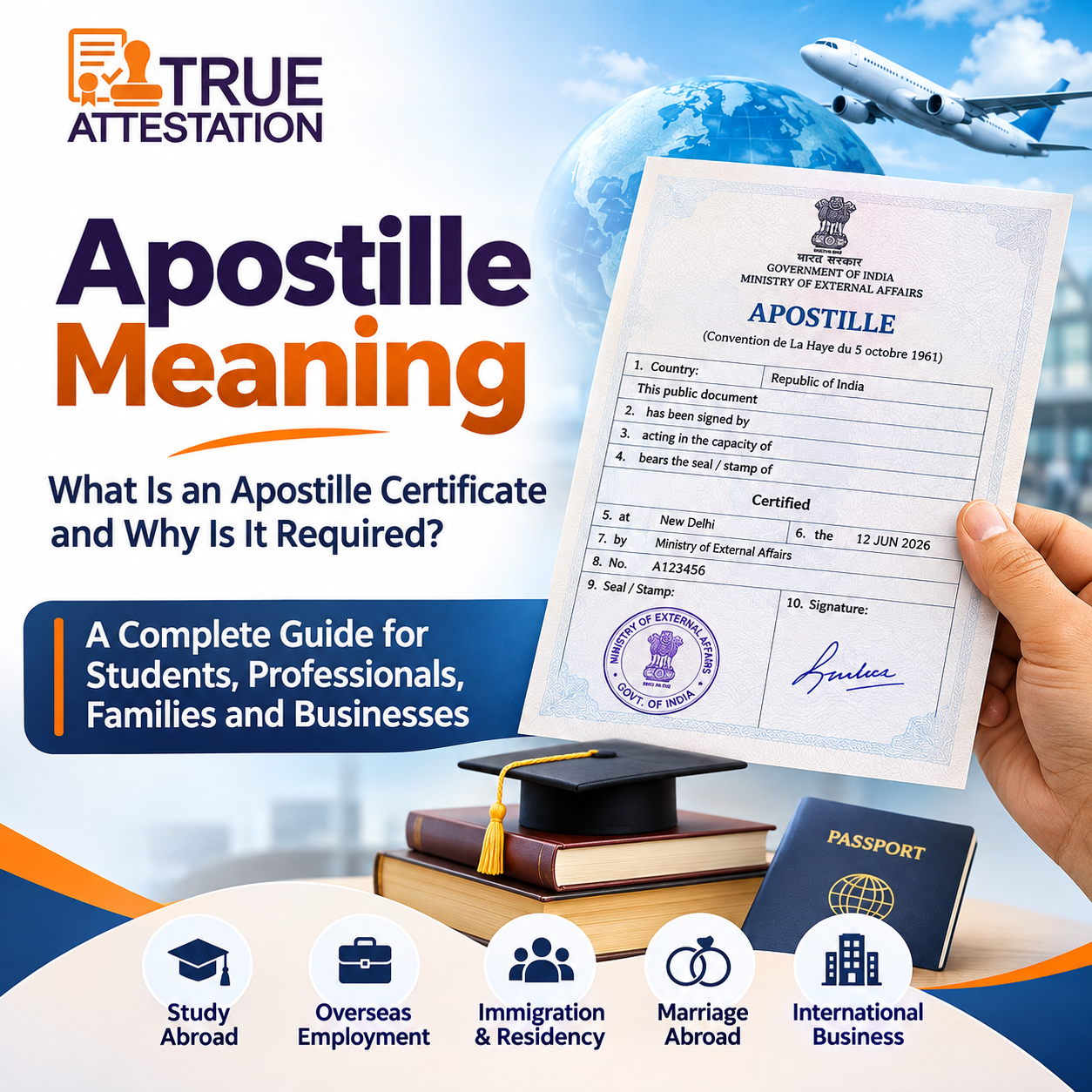
An apostille certificate confirms the authenticity of the signature on a public document, the capacity in which the person signing it acted and, where applicable, the identity of the seal or stamp attached to it.
It does not verify the truth of the document’s contents or certify that every statement in the document is legally correct.
Why Was the Hague Apostille Convention Introduced?
The Convention was introduced to make international document legalisation easier and more consistent.
Its objectives include:
- Reducing unnecessary embassy and consular legalisation.
- Simplifying international document authentication.
- Making the verification of official signatures easier.
- Reducing administrative burden for individuals and businesses.
- Supporting international education, employment, immigration and commercial transactions.
The Hague Apostille Convention India system helps eligible applicants avoid the traditional multi-stage legalisation procedure when the Convention applies between the countries concerned.
Hague Apostille Convention India: India’s Participation
India joined the Hague Apostille Convention by accession on 26 October 2004, and the Convention entered into force for India on 14 July 2005.
India’s designated competent authority for issuing apostilles is the Ministry of External Affairs (MEA), Government of India.
The MEA handles the central authentication stage by verifying the authorised signature or seal presented through the applicable authentication process and affixing the apostille to eligible documents.
Understanding Hague Apostille Convention India requirements is important because Indian documents may need authentication before being submitted to universities, employers, immigration departments, foreign courts, government institutions or business organisations abroad.
Role of the Ministry of External Affairs
The MEA is responsible for central apostille authentication of eligible Indian documents.
The general process involves:
- Verification of the document’s preliminary authentication, where required.
- Authentication of the relevant signature or seal.
- Issuance of the apostille certificate.
- Providing the authentication required for use in applicable Convention countries.
The apostille does not replace the original certificate. It is an authentication attached to or associated with the document.
How Does the Apostille System Simplify International Legalisation?
Before the Apostille Convention, a document intended for foreign use could require authentication from several authorities before the destination country’s embassy or consulate legalised it.
For example, a degree certificate might have required verification by an educational authority, authentication by a state authority, MEA authentication and further embassy legalisation.
The Convention simplified this process by introducing one standard apostille authentication for eligible documents between countries where the Convention applies.
Traditional Legalisation vs Apostille
| Aspect | Apostille system | Traditional embassy legalisation |
| Meaning | Standardised authentication certificate | Multi-stage document legalisation |
| Purpose | Authenticate official signature, seal and signatory capacity | Authenticate documents through a chain of authorities |
| Applicable countries | Countries where the Convention applies between them | Destinations requiring non-Convention legalisation |
| Process | Preliminary authentication followed by apostille, as applicable | State/department authentication, MEA and embassy/consulate stages, as required |
| International framework | Hague Apostille Convention | Destination-country legalisation requirements |
| Embassy legalisation | Generally not required after apostille where the Convention applies | May be required |
| Final acceptance | Subject to receiving authority’s requirements | Subject to receiving authority’s requirements |
The apostille versus embassy attestation decision depends on the destination country and the specific purpose of the document.
An apostille generally replaces embassy legalisation between countries where the Convention applies. Other destinations may require regular MEA attestation followed by embassy or consular legalisation.
Hague Apostille Convention India: Countries and Applicability
Not every country automatically accepts apostilles issued in India. The Hague Apostille Convention applies between countries where the Convention is in force and applicable to their relationship.
A country being listed as a Convention contracting party does not, by itself, establish that the Convention applies between every pair of countries. Accession acceptance, objections, declarations, territorial application and entry-into-force details can affect applicability.
Before applying for an apostille, verify the destination country’s status using the official HCCH status table.
Official HCCH status table: https://www.hcch.net/en/instruments/conventions/status-table/?cid=41
Why Country Verification Matters
The requirements may differ depending on whether you are submitting documents to:
- A Hague Apostille Convention country where the Convention applies.
- A non-Convention country requiring embassy legalisation.
- A country that has special document requirements for particular visa, immigration or educational purposes.
For example, a degree certificate intended for a participating country may require MEA apostille, while the same certificate intended for a destination outside the applicable Convention arrangements may require additional embassy authentication.
Therefore, Hague Apostille Convention India procedures should always be checked against the receiving country’s requirements before document submission.

Types of Documents Eligible for Apostille in India
The MEA apostille process covers several categories of documents, subject to eligibility and the required authentication route.
-
Educational Documents
These are commonly required for overseas education, employment, professional licensing and higher studies.
- Degree certificates
- Diploma certificates
- SSLC and PUC certificates
- Marksheets
- Transfer certificates
- School leaving certificates
- Professional qualification certificates
Apostille for educational certificates may require verification from the concerned university, education department, HRD authority or other designated authority before MEA processing.
-
Personal Documents
Personal documents are frequently needed for foreign residency, family visas, immigration, marriage registration and dependent applications.
- Birth certificates
- Marriage certificates
- Death certificates
- Affidavits
- Police Clearance Certificates (PCC)
- Single-status declarations
- Power of Attorney
- Other eligible personal documents
Requirements for apostille personal documents may vary depending on the issuing authority and document type.
-
Commercial Documents
Businesses may need document authentication to establish their legal identity or conduct international transactions.
- Certificate of Incorporation
- Memorandum of Association
- Articles of Association
- Commercial invoices
- Business agreements
- Board resolutions
- Power of Attorney
- Other eligible commercial records
Apostille for commercial documents may involve Chamber of Commerce authentication or other prescribed preliminary authentication procedures.
Hague Apostille Convention India: Apostille Process Step by Step
The apostille process in India generally involves the following stages. The specific authentication route depends on the document, issuing authority and destination country.
Step 1: Obtain the Original Document
Ensure that your certificate or document is issued by the relevant authorised institution or government department.
Check that:
- The document is genuine and complete.
- Names and personal details are consistent.
- The certificate is readable and not damaged.
- The document is eligible for authentication.
Step 2: Complete Preliminary Authentication
Before MEA apostille, the document may require authentication from the relevant state or designated authority.
Common authentication routes include:
| Document category | Possible preliminary authentication |
| Educational certificates | HRD, Education Department or designated educational authority |
| Personal documents | State Home Department or designated authority |
| Commercial documents | Chamber of Commerce or applicable authority |
| Eligible documents | SDM authentication, where accepted under the applicable procedure |
The required route is not identical for every certificate. A document should not be sent through an authentication channel without confirming its eligibility.
Step 3: Submit Through the Applicable Channel
Applicants may submit documents through applicable authorised service providers, designated collection centres, MEA Branch Secretariats, Regional Passport Offices or e-Sanad where eligible.
The submission route depends on the type of document, availability of online verification and current MEA procedures.
Step 4: MEA Authentication and Apostille
The Ministry of External Affairs verifies the relevant authorised signature or seal presented through the prescribed process and issues the apostille for eligible documents.
This is the central stage of the Ministry of External Affairs apostille process.
Step 5: Collect and Verify the Apostilled Document
Once processed, collect the document through the applicable delivery arrangement.
Check that the apostille is attached correctly and that your document is complete before forwarding it to your university, employer, immigration authority or other receiving institution.
Step 6: Submit to the Foreign Authority
Submit the apostilled document to the organisation that requested it.
Depending on the purpose, you may still need:
- Certified translations.
- Original certificates.
- Photocopies.
- Passport or identity documents.
- Supporting documents.
- Additional verification or registration procedures.
An apostille does not eliminate the receiving authority’s right to request other documents.
Hague Apostille Convention India: Document Requirements Checklist
Before beginning document apostille in India, keep the following ready.
| Requirement | Purpose |
| Original certificate or document | Primary document to be authenticated |
| Photocopy, where required | Supporting submission record |
| Applicant’s identity proof | Applicant identification |
| Passport copy, where required | Overseas application identification |
| Supporting verification documents | Issuing authority or document verification |
| Preliminary state authentication | Required for applicable categories |
| Authorisation letter | For representative submissions, where required |
| Additional documents | As requested by the designated authority |
Requirements can differ depending on the issuing institution, document category and destination country. Applicants following Hague Apostille Convention India procedures should verify their document requirements before arranging submission.

Apostille Certificate India: Processing Time and Costs
The processing time for an apostille depends on several factors, including preliminary authentication, educational verification, state department processing, MEA submission and delivery arrangements.
Possible reasons for delay include:
- Pending educational institution verification.
- State Home Department processing.
- Incomplete or incorrect documentation.
- Public holidays and working-day restrictions.
- Additional verification requirements.
- Submission or courier delays.
Applicants should begin the procedure well before their university admission deadline, employment joining date, visa appointment or relocation schedule. No fixed timeline should be assumed for every document.
Cost of Apostille in India
The total cost may include:
- State-level authentication charges.
- Educational or personal document verification charges.
- MEA apostille fees.
- Authorised service provider charges.
- Professional assistance charges.
- Courier and document handling expenses.
Fees can vary according to the document category, authentication route and service provider. Applicants should confirm the applicable government and service charges before submitting their documents.
The MEA publishes official apostille and attestation procedure information on its website.
Official reference: https://www.mea.gov.in/apostille-menu.htm
Hague Apostille Convention India: Common Mistakes to Avoid
Even a genuine document can face processing delays if the authentication procedure is incorrect. Applicants should understand Hague Apostille Convention India procedures before arranging authentication.
Avoid these common mistakes:
- Applying without checking the destination country: Verify whether the Convention applies between India and the destination country.
- Choosing the wrong authentication: Apostille and embassy legalisation are different procedures.
- Skipping preliminary authentication: Educational and personal documents may need state-level verification.
- Submitting incomplete documents: Missing photocopies, identification or supporting records can delay processing.
- Ignoring name mismatches: Differences in spelling, initials, date of birth or other details can cause complications.
- Submitting damaged certificates: Torn, unclear or altered documents may require additional verification.
- Using unauthorised channels: Submit through the applicable designated and authorised channels.
- Assuming apostille guarantees acceptance: The receiving university, employer, immigration authority or other institution may have additional requirements.
The best way to avoid complications is to confirm the authentication procedure before submitting the document. A correctly prepared Hague Apostille Convention India application can help reduce avoidable processing issues caused by incorrect authentication routes or incomplete paperwork.
Apostille Convention countries (official status list)
- Albania
2. Algeria
3. Andorra
4. Antigua and Barbuda
5. Argentina
6. Armenia
7. Australia
8. Austria
9. Azerbaijan
10. Bahamas
11. Bahrain
12. Bangladesh
13. Barbados
14. Belarus
15. Belgium
16. Belize
17. Bolivia
18. Bosnia and Herzegovina
19. Botswana
20. Brazil
21. Brunei Darussalam
22. Bulgaria
23. Burundi
24. Cabo Verde (Cape Verde)
25. Canada
26. Chile
27. China
28. Colombia
29. Cook Islands
30. Costa Rica
31. Croatia
32. Cyprus
33. Czechia
34. Denmark
35. Dominica
36. Dominican Republic
37. Ecuador
38. El Salvador
39. Estonia
40. Eswatini
41. Fiji
42. Finland
43. France
44. Georgia
45. Germany
46. Greece
47. Grenada
48. Guatemala
49. Guyana
50. Honduras
51. Hungary
52. Iceland
53. India
54. Indonesia
55. Ireland
56. Israel
57. Italy
58. Jamaica
59. Japan
60. Kazakhstan
61. Kosovo
62. Kyrgyzstan
63. Latvia
64. Lesotho
65. Liberia
66. Liechtenstein
67. Lithuania
68. Luxembourg
69. Malawi
70. Malta
71. Marshall Islands
72. Mauritius
73. Mexico
74. Monaco
75. Mongolia
76. Montenegro
77. Morocco
78. Namibia
79. Netherlands
80. New Zealand
81. Nicaragua
82. Niue
83. North Macedonia
84. Norway
85. Oman
86. Pakistan
87. Palau
88. Panama
89. Paraguay
90. Peru
91. Philippines
92. Poland
93. Portugal
94. Republic of Korea (South Korea)
95. Republic of Moldova
96. Romania
97. Russian Federation
98. Rwanda
99. Saint Kitts and Nevis
100. Saint Lucia
101. Saint Vincent and the Grenadines
102. Samoa
103. San Marino
104. Sao Tome and Principe
105. Saudi Arabia
106. Senegal
107. Serbia
108. Seychelles
109. Singapore
110. Slovakia
111. Slovenia
112. South Africa
113. Spain
114. Suriname
115. Sweden
116. Switzerland
117. Tajikistan
118. Thailand
119. Tonga
120. Trinidad and Tobago
121. Tunisia
122. Türkiye (Turkey)
123. Ukraine
124. United Kingdom
125. United States of America
126. Uruguay
127. Uzbekistan
128. Vanuatu
129. Venezuela
130. Viet Nam

Apostille Services in Bangalore – How True Attestation Can Help
True Attestation assists individuals, students, professionals, families and businesses with document authentication requirements for international use.
If you are searching for apostille services in Bangalore, getting guidance on the correct procedure can help you understand which preliminary authentication is required, what documents need to be submitted and which legalisation route applies to your destination.
Our assistance includes:
- Educational certificate apostille.
- Personal document apostille.
- Commercial document apostille.
- HRD attestation assistance.
- State-level authentication guidance.
- MEA apostille coordination.
- Embassy attestation guidance.
- Document verification and application preparation.
- Authentication assistance for documents intended for different international destinations.
Whether you need Hague Apostille Convention India guidance for overseas education, employment, family immigration, business transactions or foreign residency, the correct procedure depends on the document and the receiving country’s rules.
True Attestation can help you understand the document authentication process and prepare for the applicable procedure. Our document apostille assistance helps applicants understand the preliminary authentication requirements and the next steps for MEA processing.
Frequently Asked Questions About Hague Apostille Convention India
- What is the Hague Apostille Convention?
The Hague Apostille Convention is an international treaty that simplifies the authentication of public documents for use in participating countries. It replaces the traditional chain of legalisation with a standardised apostille certificate where the Convention applies.
- Is India a member of the Hague Apostille Convention?
Yes. India acceded to the Convention on 26 October 2004, and it entered into force for India on 14 July 2005. The MEA is India’s designated competent authority for apostille issuance.
- Why was the Hague Apostille Convention introduced?
It was introduced to reduce the complicated, multi-stage legalisation procedure for international public documents, making authentication simpler for individuals, organisations and businesses.
- What is the purpose of an apostille certificate?
An apostille authenticates the relevant signature, official capacity of the signatory and, where applicable, the seal or stamp on a public document. It does not certify the truth of the document’s contents.
- What is the difference between apostille and embassy attestation?
Apostille is a simplified authentication under the Hague Convention. Embassy legalisation is a separate process used when the destination country requires it or the Convention does not apply between the countries.
- Which countries accept apostille?
Countries where the Hague Apostille Convention is in force and applicable to the relationship generally accept apostilles for eligible documents. Always check the current official apostille countries list and the destination country’s requirements.
- How can I get apostille in India?
Obtain your original document, complete the required preliminary authentication, submit it through the applicable authorised channel for MEA processing and collect the apostilled document after processing.
- Is HRD authentication required before apostille?
Some educational certificates require HRD, Education Department, university or other designated authority verification before MEA apostille. The required route depends on the certificate, issuing authority and applicable procedure.
- How long does apostille take in India?
Processing time varies depending on preliminary authentication, document verification, MEA processing and submission arrangements. Apply early and confirm the current estimated timeline with the relevant service provider.
- Can I apostille my degree certificate in Bangalore?
Yes, eligible degree certificates issued in India can be processed for apostille through the applicable authentication route. The certificate may require university or state educational authority verification before MEA processing.
- Does apostille guarantee acceptance of my document abroad?
No. Apostille authenticates the relevant signature, seal or signatory capacity. It does not guarantee acceptance for admission, employment, immigration, licensing or any other purpose.
- Is apostille required for UAE documents?
Applicants must verify the current legalisation requirements between India and the UAE and the receiving authority’s requirements for the specific document and purpose. Do not assume that apostille alone is sufficient for every UAE-related submission; confirm whether additional authentication or legalisation is required.
Conclusion: Understanding Hague Apostille Convention India Requirements
The Hague Apostille Convention India procedure is an important part of international document authentication for individuals and organisations preparing Indian documents for overseas use.
The Hague Apostille Convention has simplified international document legalisation by introducing a standard authentication system for eligible public documents used between countries where the Convention applies.
For Indian applicants, understanding Hague Apostille Convention India requirements is important before applying for overseas education, employment, immigration, family visas, business registration or foreign residency. India participates in the Convention through its Ministry of External Affairs, which issues apostilles after the applicable document authentication process.
The correct procedure depends on your document category, issuing authority and destination country. Educational certificates, personal documents and commercial records may follow different preliminary authentication routes. Apostille also does not replace the receiving institution’s requirements for translations, supporting records or acceptance.
Before submitting your documents, verify the destination country’s current Convention status and confirm the required legalisation procedure.
If you need help with apostille, document authentication, HRD verification or embassy legalisation in Bangalore, True Attestation can assist with document preparation, authentication guidance and apostille coordination.
Contact True Attestation for professional assistance with your document authentication requirements and get guidance on the appropriate process for your international destination.
True Attestation
Phone: +91-9380152536
Email: info@Trueattestation.com
Website: www.trueattestation.com
Visit: No 39/4, 1st Floor, Behind Dominos Pizza, E Anjaneya Temple Street, Bull Temple Road, Gandhi Bazaar, Basavanagudi, Bangalore, Karnataka – 560004
Official Sources
- Ministry of External Affairs, Government of India: https://www.mea.gov.in/apostille-menu.htm
- Hague Conference on Private International Law (HCCH): https://www.hcch.net/
- Official Apostille Convention Status Table: https://www.hcch.net/en/instruments/conventions/status-table/?cid=41